

WHOOP’s four-year Formula 1 deal puts live driver heart rates on TV from 2027, but getting drivers to say yes is the hard part.
Three days before the Las Vegas Grand Prix, Will Ahmed (Founder & CEO, WHOOP) and Stefano Domenicali (CEO, Formula 1) got on stage, and showed a demo reel of Charles Leclerc’s heart rate.
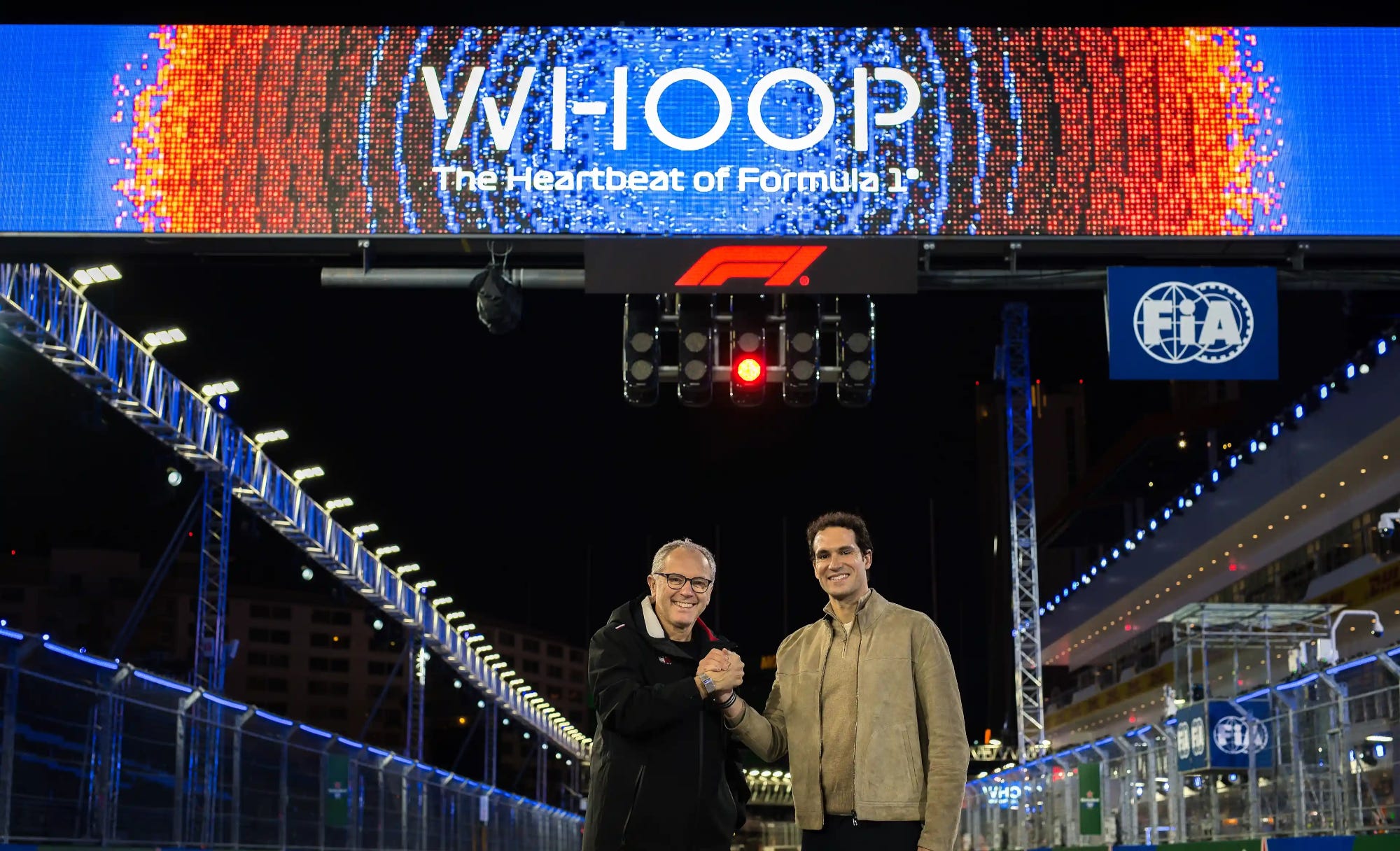
It’s Charles’s data, not the car’s. And that’s a first.
For 75 years Formula 1 has told us almost everything about the machine and next to nothing about the person strapped into it. That changes from the 2027 season.
WHOOP signed a four-year global partnership with Formula 1 on 18 November 2026. The deal makes it the Official Health & Fitness Wearable Partner of Formula 1 and, according to WHOOP, the first consumer wearable the FIA has approved for in-race use. From 2027, Formula 1 will show real-time physiological data from participating drivers during race broadcasts through a feature called WHOOP Live.
On the flipside, Max Verstappen has already said he won’t take part, which tells you where the real constraint sits.
What WHOOP signed with Formula 1
The headline terms are simple. It’s four years and global, and WHOOP also becomes Official Health & Fitness Wearable Partner of F1 ACADEMY. It gets trackside branding, “Performance Lab” fan zones at several races and content across F1’s channels. The financial terms weren’t disclosed but on the face of it, it looks like a clever move for WHOOP, F1, and the fans.
The idea is that drivers wear the strap on the bicep inside a fire-resistant sleeve the FIA has signed off, and Las Vegas was the first race where they were allowed to wear it. From 2027, the broadcast will carry live heart rate, heart-rate zones and a stress reading based on heart rate variability, with sleep and recovery trends to follow. Reuters reports that the number of participating drivers is expected to reach double figures early next season.
Some drivers seem up for it, or maybe they’re just PR-trained. Liam Lawson said he was curious whether his rivals are stressed, because, in his words, “we want to put them under as much stress as possible.” As a fan, it would definitely enhance the viewing experience.
The measurement actually isn’t new at all. Since the 2018 Australian Grand Prix, drivers’ gloves have carried an optical sensor that measures pulse and blood oxygen. That feed goes to the medical car, though, not to your living room (but I would be curious to see how that data compares to WHOOP’s data over time). The sport has been measuring drivers’ hearts for eight years. It just never thought to show anyone, and I’m sure that part will lead to some more controversy.
The data is the advert
Every sponsor buys attention, and WHOOP has essentially bought a live product demo.
A logo on a sidepod tells you a brand exists. A heart-rate overlay showing Leclerc at 180bpm into Turn 1 tells you what the product does, live, to an audience F1 puts at 827M fans, 43% of them under 35. Ahmed has already written the punchline too, as he expects fans to be struck by how fit drivers are, with race heart rates around 170 to 180bpm.

No comment.
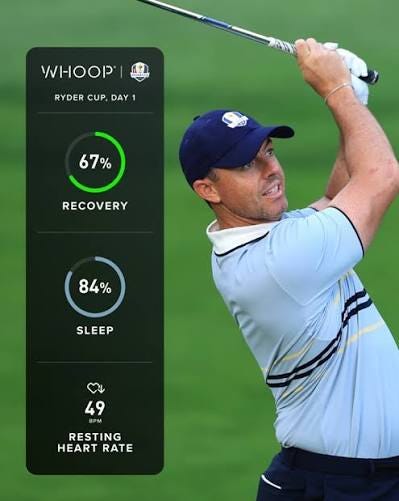
In all seriousness, WHOOP has run this play before. Its PGA TOUR partnership started in 2021 and has been extended through 2028, alongside broadcast integrations at the Tour de France and the Giro d’Italia. Golf proved the format: When Rory McIlroy won back-to-back Masters in April, WHOOP data showed his heart rate spiked to 135bpm after his drive on the 18th sailed right and put the title in jeopardy.
The open question for Formula 1 and WHOOP is whether a heart-rate graphic stays interesting in race 14, once the novelty of race one has gone. One to watch!
Consent is the bottleneck
You can make sensors by the thousand, but personal consent has to be won one driver at a time.
Luckily there are only 22 of them, but Verstappen has already said he’s out. He doesn’t use any tracker, even in training, and told The Race: “I don’t like to be tracked and I know when I’m tired.” (Honestly, the most Max sentence ever)
In the same piece, George Russell said he wouldn’t refuse but warned that comparisons could mislead, because heart rates vary with age and physiology, and the grid runs from a 19-year-old to a 45-year-old. Leclerc is in, and says he has nothing to hide. He is also a WHOOP ambassador though so take that as you will.
Domenicali reckons the holdouts will come round, the way teams did with Drive to Survive. He might be right. But Drive to Survive asked drivers for their personalities. This asks for readings from their autonomic nervous systems. Under GDPR and the UK Data Protection Act, health data is special-category information. WHOOP’s own privacy principles commit it to aggregated or de-identified data for research, and a named driver’s heart rate on live TV is the opposite of that. Ahmed says some data will stay private and that teams will get fuller data packages than fans.
WHOOP has met this question before. Its deal with the NFL Players Association let players own their health data and sell it. Pushed far enough, that model turns the athlete into a data licensor and the sensor company into a paying tenant. Whoever builds the consent and rights layer for athlete data may end up with more leverage in this market than whoever builds the next sensor.
What this means for the Performance layer
This is the path from elite sport to the consumer market, happening on live television.
At Momentous we back tools that athletes and teams adopt first and that later spread to everyone else. WHOOP’s F1 journey is a near-perfect example. In January, WHOOP was rolled out across the whole Ferrari team, with Ferrari’s medical staff working with WHOOP’s performance science group led by Dr Kristen Holmes. Ten months later it covers the whole championship. The F1 ACADEMY piece is no afterthought either: WHOOP says new female members grew 150% year on year in early 2026, and it has just bought a stage for that audience.
For founders, Russell’s complaint is effectively a product brief. A raw heart rate means very little without a baseline, an age, a history and a race situation behind it. Turning a single number into an honest explanation is applied AI on proprietary data, and that is where a defensible moat lies.
Sensors are becoming a commodity. Access, distribution, and the ability to explain what the readings mean are not.
So what?

WHOOP’s F1 deal is a test of whether biometric data can become entertainment without turning into a number that misleads people. It’s the same trust question the World Cup’s officiating tech had to answer.
Picture 2027. A heart rate spikes on screen and a commentator says “he’s rattled”. If that’s how it goes, Russell’s warning becomes the story and more drivers follow Verstappen. If the graphic carries context (the driver’s baseline, the zone they’re in, what a spike means at 19 compared with 45), fans get a real insight into how hard this sport is.