

On 11 June, at Estadio Azteca, Julián Quiñones scored the first goal of the largest World Cup ever staged. Few people will remember the finish. What will stick though is the angle: a clean point-of-view shot from a small camera mounted on referee Wilton Sampaio’s headset. The first time in World Cup history an official had worn one, stabilised in real time by an AI system that stripped out nearly all the motion blur a sprinting referee’s head produces. By FIFA’s count, six billion people had access to a perspective that, in every prior tournament, existed only inside one person’s head.
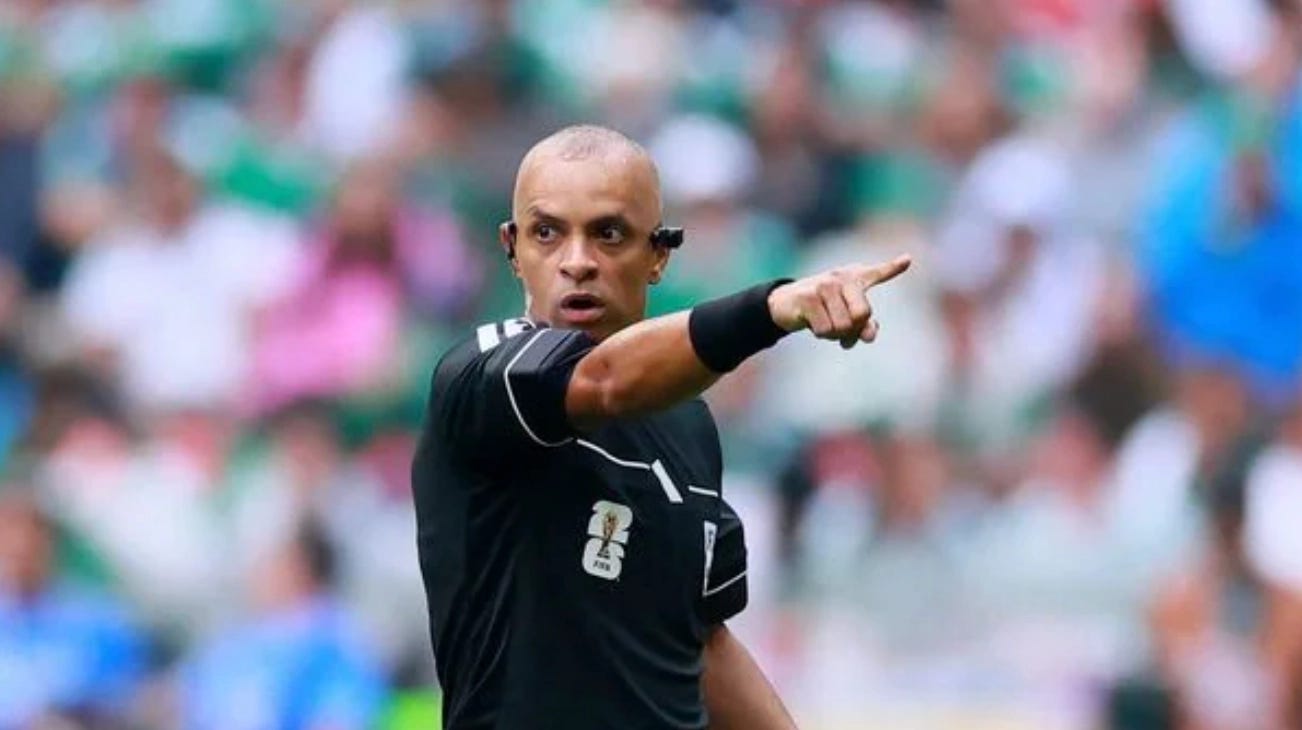
That camera angle was a useful way to see what was actually happening at the tournament. The opener alone needed every bit of officiating support available with three red cards before the final whistle, the most in any World Cup opening match. The tech being used to support the match officials didn’t turn into a conversation about AI replacing referees or predicting outcomes (though “prediction” [read betting] markets did have a successful tournament as well).
The story was narrower and much more interesting than that: a layered stack of computer vision, sensors, and generative models, built to make football’s most contested decisions visible, explainable, and fast enough to matter while the match was still live.
Moving at the speed of the game
Semi-automated offside technology debuted in Qatar in 2022, but it only flagged a player once they were more than 50cm offside, and even then the alert routed through the VAR room before anyone on the pitch heard about it. That delay was why assistant referees were trained to hold their flag and let play develop. An unnecessary step that slowed down the game and dampened the excitement. It also contributed to Nottingham Forest striker Taiwo Awoniyi’s serious abdominal injury in 2025, one of the incidents officials pointed to when arguing for change. This year, FIFA thankfully tightened the threshold to 10cm and rewired the alert to go straight into the official’s earpiece. The flag went up the moment a violation was clear, not after a video booth confirmed it.
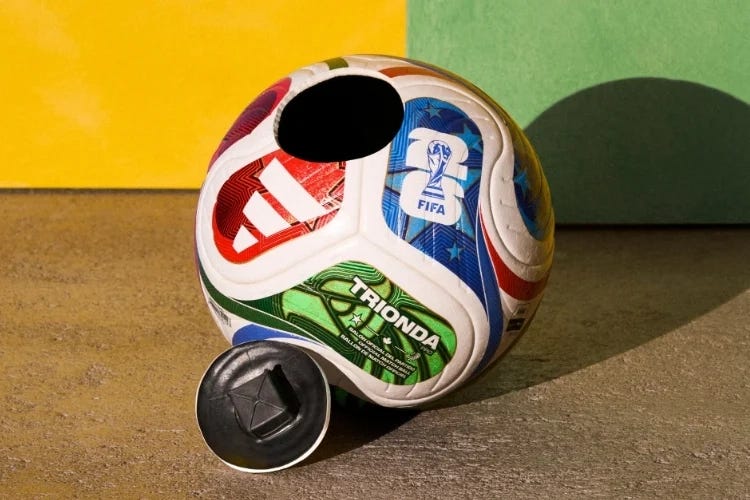
The system still couldn’t do everything though. It only caught positional offside, not interference, and it sat out the closest calls entirely. Underneath it sat another piece of hardware doing a lot of the actual work. The Adidas Trionda (official match ball) carried a motion sensor recording 500 times a second, precise enough to mark the exact instant of a kick or a handball touch and feed that timestamp straight into the system. Paired with it was something equally impressive. Every player got a precise 3D body scan before the tournament, accurate enough to track them through a crowded box or a collision.
Any football fan will tell you that offside has always been less a measurement problem than a trust problem. Fans don’t reject calls because they’re wrong, they reject them because they’re inscrutable. A clean 3D reconstruction on the broadcast went a long way in providing that trust factor. FIFA pushed that same instinct into the stadium itself, ensuring that after a VAR review, the referee now explained the call out loud over the public address system, instead of leaving thousands of people in the stands to guess from the players’ reactions. This has been a common practice across various other sports for years, but it’s good to see that football has now caught up.
The importance here is that FIFA didn’t just make the system more accurate, it made the accuracy legible to the people it affected. A verdict without a trustworthy and verifiable explanation (however accurate it may have been) would not have had the same impact on the game. A faster, more correct decision nobody understands still loses the room. But a decision people can see for themselves doesn’t need defending at all. Well, maybe a little, it’s still passionate football fans we’re dealing with here!
That lesson held in reverse, too. During Qatar’s group match against Switzerland, the system that generates the offside graphic crashed before a contested penalty decision, leaving FIFA with no animation to show and only a statement insisting the underlying call was correct. The explanation arrived without the evidence, and that wasn’t enough. Pundits accused FIFA of hiding something even though the call may well have been clean. The failure wasn’t in the offside decision itself, but in the layer built to make the decision visible. The layer people actually trust.
Analysis for all
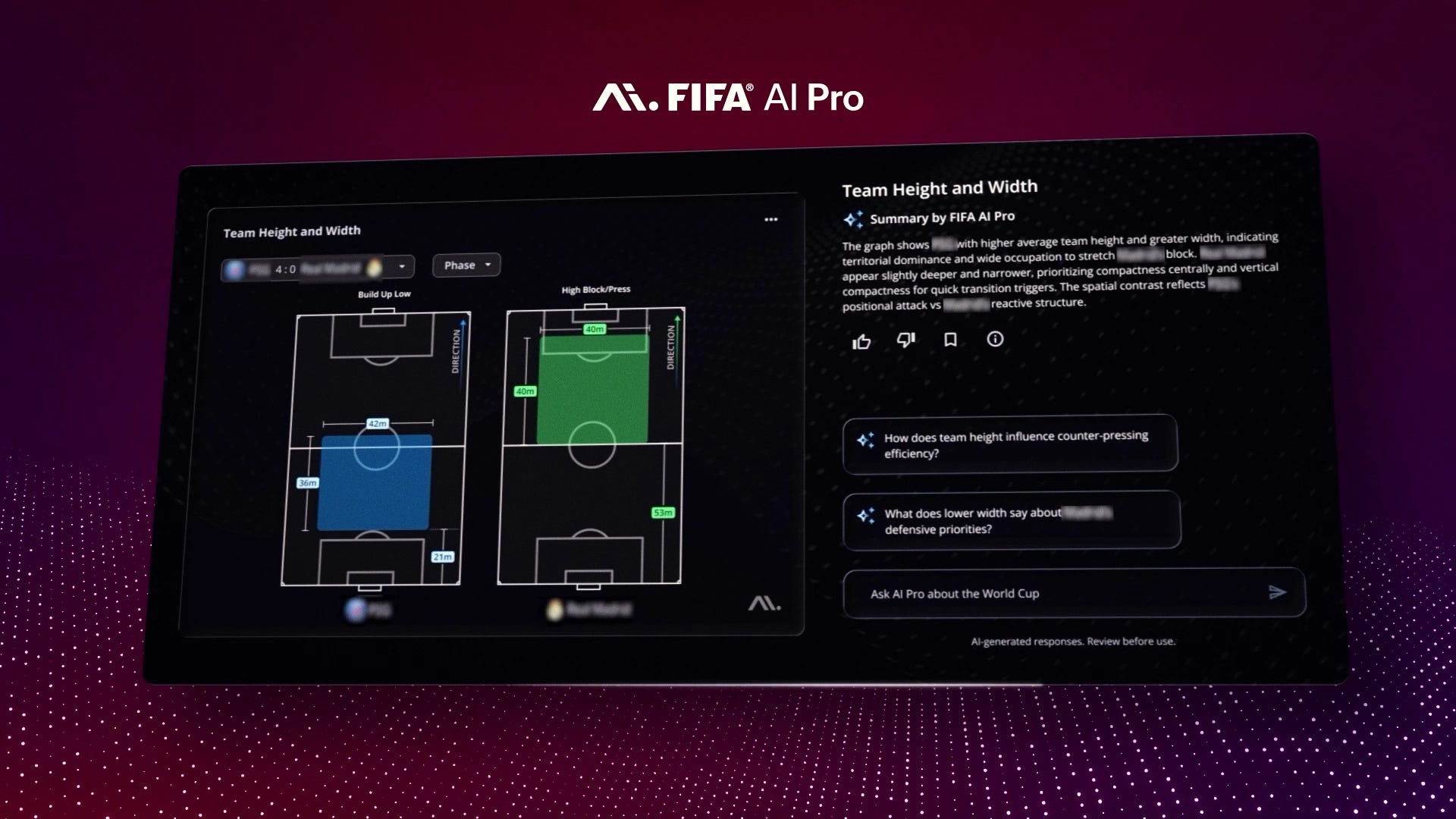
Lenovo’s partnership saw them build FIFA AI Pro, a generative assistant trained on FIFA’s own match data, which was given to all 48 competing teams equally. It answered questions about opponents and tactics in text, video, and 3D visualisation, in whatever language a federation needed.
The gap between a team with a full analytics department and one without has long been one of the clearest predictors of how far a squad could go. Handing every federation the same digital assistant closed that preparation gap, giving teams that couldn’t afford an analytics department access to one.
Fans inside stadiums equally had access to their own analysis. They could point their phones at the pitch through the FIFA+ app to see an augmented reality overlay showing real-time player names, speeds, and physical intensity. The same data layer powering officiating decisions, surfaced directly into the stands.
The unglamorous bottleneck
A 48-team format meant 104 matches across three countries. A level of volume that could have easily broken the old broadcast playbook. Verizon deployed private 5G networks at all 16 venues, with capacity at the 11 US stadiums upgraded by up to five times to handle the volume of fans streaming and uploading simultaneously. Lenovo ran near-real-time infrastructure out of Dallas to log, tag, and clip footage fast enough to keep up, and the Referee View stabilisation alone cut visual jitter by roughly half.
None of those individually made major headlines, but combined they did make the world cup watchable at global scale. It was the part of the stack that got the least credit while enabling everything else on top of it.
The off-pitch trust problem
The same month the tournament opened, a clip of a Boston Dynamics robot dog patrolling a Dallas concourse went viral, captioned as proof that fans were being secretly face-scanned. Boston Dynamics and FIFA both confirmed the robots had no facial recognition capability; their job was perimeter checks and flagging suspicious packages to human security. Still eerily close to a Black Mirror episode…
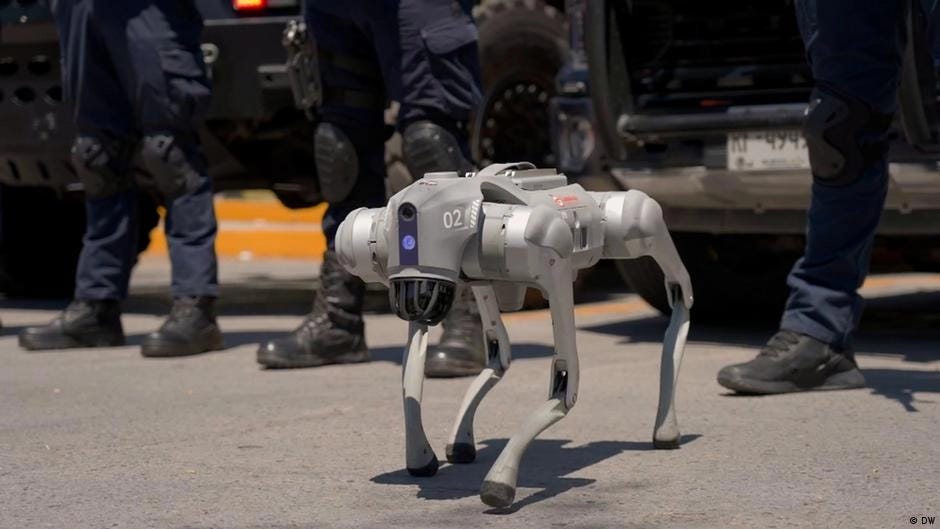
The irony was that the real version of the facial recognition fear did exist, just not where anyone was looking. Several US stadiums ran actual AI-powered facial recognition for entry and payment throughout the tournament. The public aimed its suspicion at the unsettling machine that couldn’t see faces and missed the mundane turnstile that discreetly could.
So what?
Strip away the broadcast graphics and the World Cup ran the same stack every company building in elite performance eventually has to reckon with: sensing, real-time inference, decision support, explainability, distribution, and governance, compressed into 39 days and 104 matches.
What separated the systems that worked from the ones that were just noise? Every one of them tried to make a decision faster and more legible to the people who had to trust it.
That’s the discipline worth carrying out of this tournament. The products that last aren’t the ones forecasting what will happen. They’re the ones that make a decision actionable and trustworthy.
Good analysis of how AI can create transparency in football! Fascinating stuff