

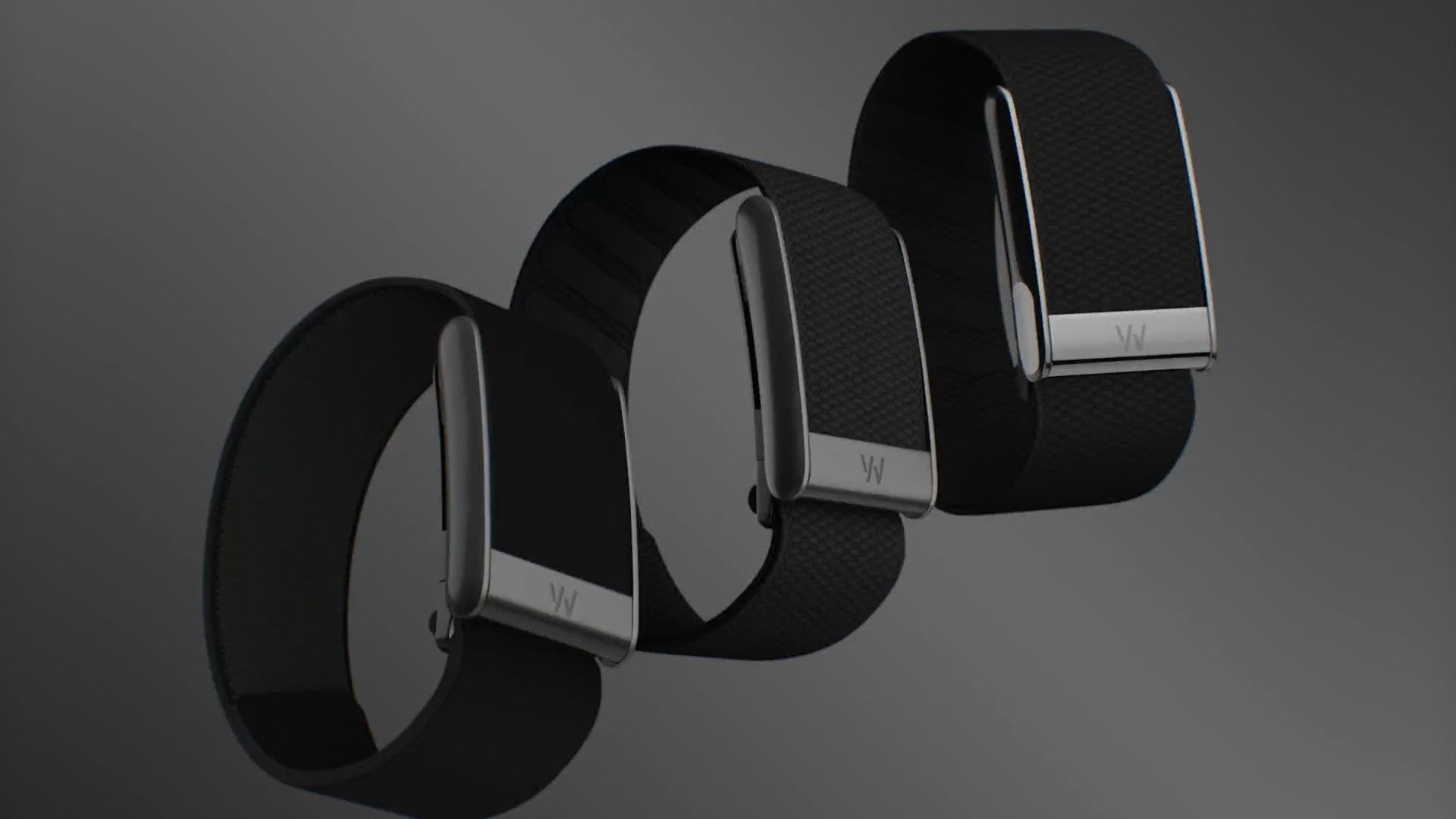
Most wearables tell you what you’ve already done. Step counts. Calories burned. Workouts logged. They are, in essence, digital rearview mirrors — useful, perhaps, but fundamentally oriented toward the past.
WHOOP was built on the opposite bet: that the most valuable thing a device could do is tell you something you don’t already know. While humans are genuinely good at sensing their own physiological state, we still get certain things wrong. We confuse adrenaline with readiness. We mistake exhaustion for weakness. We train hard on days when we should be recovering, and call it discipline.
That insight began, in 2011, with a Harvard squash captain who noticed something elementary: athletes had no reliable way to know when they were recovered enough to train hard again. They went by feel. Will Ahmed (founder & CEO of WHOOP) spent the next several years and over 500 medical papers proving there was a better way — that Heart Rate Variability (HRV), the subtle variation in timing between heartbeats, was a precise and continuous window into whether the body was ready to perform or quietly breaking down. The problem at the time was that measuring it clinically required a $20,000 ECG machine and a hospital visit.
Ahmed set out to change that.

In a wearables market projected to reach ~$200 billion by 2030, and littered with the wreckage of hardware startups that failed to compete with Apple, Google, and Amazon, WHOOP has carved out a $10.1 billion valuation and a user base that borders on evangelical. What follows is an account of how, and a look at what comes next.
Technology Risk, Not Just Market Risk
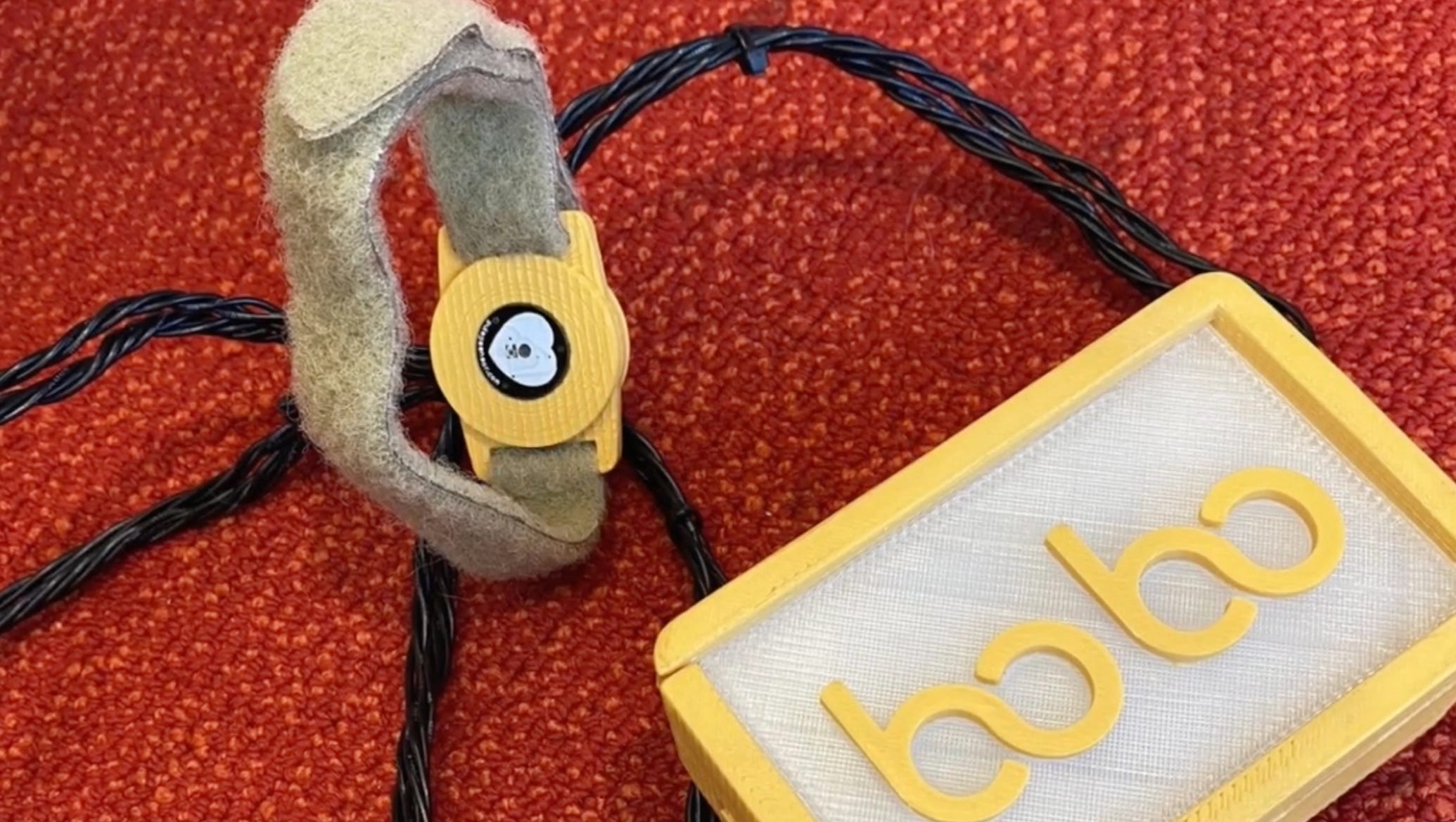
WHOOP’s V1 prototype (aka Bobo) was not a sleek wearable. It was a bulky orange box tethered to a wall and a computer, built for a single purpose: to prove that clinical-grade HRV measurement from the wrist was even possible.
This is worth dwelling on. Most consumer hardware startups take on market risk — they build something using existing technology and bet that people will want it. WHOOP took on technology risk first. They spent years and millions of dollars solving a genuinely hard scientific problem before they had a product worth selling. The sensor had to be accurate enough to replace an ECG. The algorithms had to be validated against clinical standards. There were no shortcuts, because the entire value proposition depended on the data being trustworthy.
That upfront investment in technological credibility became the foundation of everything else. When WHOOP eventually told elite athletes that their device was as accurate as hospital equipment, it was true — and the athletes knew it, because the data matched what their own coaches and physiologists were seeing.
The depth of that investment also produced something nobody designed for. During the COVID-19 pandemic, WHOOP’s data science team noticed that a sudden spike in respiratory rate was a reliable leading indicator of infection — alerting users, including several PGA Tour golfers, to test themselves days before symptoms appeared. The device wasn’t built to do that. It just happened to be measuring the right things, continuously, at clinical resolution. That predictive capability — sensing what the body is doing before the conscious mind catches up — became WHOOP’s clearest proof of concept for everything that followed.
You can’t retrofit credibility.
Why Elite Athletes Actually Mattered
The conventional reading of WHOOP’s early strategy is that they used celebrity athletes as marketing. That somewhat misses the deeper logic. Targeting LeBron James, Michael Phelps, and Cristiano Ronaldo early served two purposes that had nothing to do with brand awareness.

The first was accuracy. Working with the world’s best athletes created a brutal feedback environment. These were people whose livelihoods depended on understanding their bodies with precision, supported by teams of physiologists and coaches who would immediately flag anything that didn’t hold up. If WHOOP’s data was wrong, they would know — and they would say so. This forced WHOOP to build the most accurate technology possible, preventing any temptation to cut corners for the mass market.
The second was cultural reframing. Historically, medical monitoring devices carried a stigma. If you wore one, something was wrong with you. WHOOP needed to invert that association entirely — to make health tracking feel not like a medical necessity but like an elite performance tool. Having it on the wrist of Olympians accomplished that in a way no advertising campaign could. When the NBA briefly banned players from wearing WHOOP on court and players started sneaking them on anyway, that told a story about desirability that money couldn’t buy. More recently, Sinner, Sabalenka and Alcaraz were banned from using fitness trackers, after the latter was busted for wearing a WHOOP under his wristband at the Australian Open.
Marketing stunt or not… the point stands: WHOOP has become, in the culture of elite sport, a signal that you are serious. Beyond the world of professional athletes it has become a mainstream status symbol for entrepreneurs, tech bros, VCs, and more broadly anyone who cares about their performance.
That cultural repositioning — from “medical device” to “high-status performance tool” — is one of the most important moves in the company’s history. The lesson isn’t to find famous ambassadors. It’s to identify the cultural frame that makes your product mean something different, and find the people who can make that frame credible. The awareness follows. It doesn’t lead.
From Hardware Sale to Health Subscription
WHOOP’s original commercial launch charged $500 upfront for the hardware. However, watching the valuations being attached to SaaS businesses, Will Ahmed made the contrarian decision to flip the model entirely: give the hardware away for free, and build the business on recurring subscription revenue.
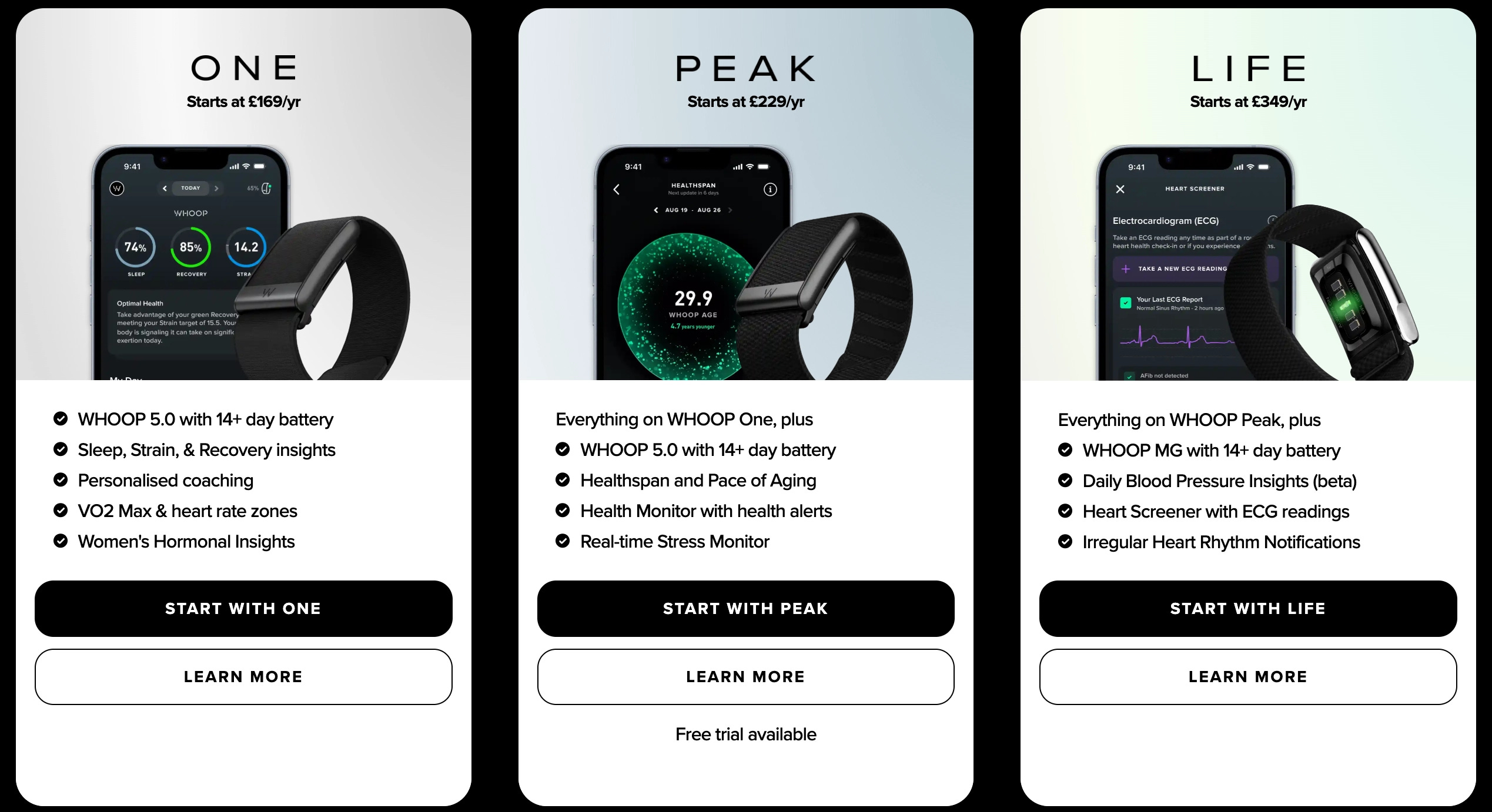
The current packaging reflects a deliberate strategy to lower the barrier to entry while capturing increasing value from engaged users over time. The core tiers run from £169/$199 per year for the standard WHOOP 5.0, up to £349/$359 per year for the “WHOOP Life” tier, which unlocks medical-grade features including on-demand AFib detection and daily blood pressure monitoring. Critically, subscribers who maintain at least 12 months of remaining commitment receive hardware upgrades at no additional cost. It’s a powerful retention mechanic that makes the question of whether to upgrade your device disappear (kind of). Despite the company’s loyal customer base, the fine print caused Whoopgate — some intense online backlash after founding members and early adopters who were promised “free upgrades” still had to pay extra, when the WHOOP 5.0 came out last year. More on that below.
Beyond the core subscription, WHOOP has built a deliberate ecosystem of adjacent revenues with each layer expanding either the product’s surface area or its share of the user’s health spending. WHOOP Pro adds a $12 monthly fee for apparel discounts. WHOOP Body (smart garments that house the sensor in clothing rather than on the wrist) reinforces the “invisible infrastructure” positioning while opening a new hardware category. And straight from the Apple Watch playbook, premium accessory bands, including Italian leather options, address the fashion dimension without compromising the core product identity.
The more strategically significant moves are at the platform level. The integration of clinical blood test panels is an early land-grab on the user’s broader health spending — pulling laboratory diagnostics into the same subscription relationship as continuous monitoring. The women’s health expansion does something similar for an underserved market. Cycle phase has measurable effects on HRV, recovery capacity, and sleep quality that a dedicated period-tracking app cannot capture with the same fidelity. WHOOP’s continuous architecture is structurally well-suited to it in a way most competitors aren’t. For a platform historically associated with male-dominated performance sport, it is both a meaningful product differentiation play and a significant TAM expansion.
What Customers Are Actually Buying
When someone signs up for WHOOP, they are not purchasing a step-counter or a piece of fabric and plastic. They are entering into a continuous conversation with their own physiology. The value exchange operates across several distinct dimensions.
Predictive coaching. By quantifying both Strain (how much stress the body has accumulated) and Recovery (how well it has responded), WHOOP can tell users not just what happened yesterday, but what tonight’s sleep needs to look like to perform well tomorrow. This forward-looking orientation — living a step ahead of the user rather than behind them — is what sets it apart in the category.
Early-warning signals. The COVID case is the most dramatic example, but the principle applies broadly. WHOOP transitions health monitoring from a reactive system into a proactive one. Users report being alerted to overtraining, illness onset, and menstrual cycle disruptions before they consciously registered anything was wrong. That peace of mind, for the right user, is worth far more than the subscription price.
Identity and belonging. WHOOP is screenless, invisible under a sleeve, and communicates nothing to the outside world except that you wear it. Yet it has become a high-status signal in performance-oriented communities — a marker that you take your body seriously. That identity dimension drives organic word-of-mouth in a way that product features alone cannot.
Team and enterprise performance. Through WHOOP Unite, the product scales beyond the individual. Sports franchises, Formula 1 teams, the military, and corporations are using aggregated workforce data to manage recovery, reduce burnout, and optimise collective performance. This B2B layer represents a significant and still-underappreciated part of the commercial story.
Unit Economics and the J-Curve
Because WHOOP absorbs the hardware cost upfront, the cashflow shape is unusual and worth understanding clearly.
The early devices cost somewhere between $150 and $300 to manufacture. Over time, WHOOP has brought that down to an estimated $20-$50 depending on generation and volume (excl. R&D costs). WHOOP effectively finances that cost on behalf of the subscriber. With a $239 annual subscription (which is ideally for them paid upfront), the company is aiming to recover blended customer acquisition costs and hardware costs well within the first year. Every month a subscriber remains beyond that payback period generates high-margin software revenue with no incremental hardware cost. This is why retention is not just important to WHOOP — it is the entire model.
Customer acquisition costs are kept relatively low by the top-down flywheel that the elite athlete strategy created. Ronaldo, Sabalenka, Mahomes, the PGA Tour, and more recently organisations such as Ferrari F1 and PSG repping WHOOP in public generates aspiration and awareness that would cost hundreds of millions more in paid ads to replicate. The company has built a compelling brand that over time pulls customers toward it.
Annual churn (~10%), historically, has been lower than you might expect for a hardware subscription, with CAC/LTV reportedly sitting somewhere around the 4x mark. The reason is structural: WHOOP is one of the few wearables that demonstrably changes behaviour over time. Users who stay on the platform for a year measurably lower their resting heart rate, improve sleep consistency, and develop new habits around recovery. That said, a growing number of consumers stop paying the monthly subscription and churn once they have understood their core health patterns — a dynamic that Advanced Labs is directly designed to address, by continuously raising the ceiling on what the platform can tell you about yourself.
The Health OS Race
WHOOP Advanced Labs, launched in September 2025, is the clearest signal yet of where Will Ahmed is actually trying to go. The feature integrates clinical blood testing directly into the WHOOP platform — covering 65 biomarkers across hormones, heart health, metabolic function, inflammation, and cognitive performance, with clinician-reviewed results and AI coaching delivered inside the app, powered by Quest Diagnostics. Over 350,000 members had joined the waitlist before the feature even launched — a level of pent-up demand that tells you something important about what WHOOP’s user base actually wants.

The surface-level read is that this is a smart revenue extension — a high-margin add-on that deepens engagement and raises the subscription ceiling. That’s true. But it undersells the strategic logic. What WHOOP is building toward is something more ambitious: the longitudinal health record that sits at the centre of a person’s entire health operating system (OS). Continuous biometric data from the wrist, periodic bloodwork from a lab, clinical AI interpreting the relationship between the two, and coaching that updates in real time as your body changes. In 2026, that integration has deepened further — biomarker data now flows directly into each of WHOOP’s core Healthspan pillars, with AI providing contextual guidance on what the connections mean and what to do about them. The device is no longer just measuring you. It’s building a model of you.
This is the real competitive battleground — and WHOOP is not running it alone.
In 2025 and into 2026, every major player in the wearable health space crossed the same threshold: they stopped competing on hardware specs and started competing on intelligence — who has the best AI, the most contextual data, and the stickiest coaching loop. Oura overhauled its app, making its AI Advisor genuinely contextual by finally giving it access to personal health data. Garmin launched Connect+, a paid subscription tier layering AI coaching on top of its historically hardware-led model — a significant strategic pivot for a brand that built its reputation on not needing subscriptions. Apple, Samsung, Ultrahuman, and a wave of emerging challengers are all converging on the same layer. Simultaneously, companies such as Neko Health, Superpower, and Function Health which initially ran blood and imaging tests, are now vying for a piece of the Health OS pie. And at the foundation layer, Amazon, Anthropic, and OpenAI are building health intelligence capabilities that could eventually sit beneath all of them.
The winner of this race won’t be determined by sensor quality. It will be the platform that accumulates the deepest longitudinal data, builds the most personalised, actionable AI on top of it, and makes leaving feel genuinely costly — because leaving means abandoning years of your own health history, calibrated specifically to your physiology. On that dimension, WHOOP’s head start is real. The company is already training its AI models on over 24 billion hours of continuous physiological data — a dataset no competitor can replicate without years of similar scale and commitment. By combining that foundation with over 100,000 daily data points per user and blood biomarker data, WHOOP is making a credible case for being the most complete and actionable health platform available to consumers. Whether they can execute without stumbling into the regulatory friction that ambition inevitably attracts is the question the next section addresses.
Focus as a Competitive Strategy
WHOOP has never tried to out-build Apple. That would be a losing game. Instead, it has won by refusing to play Apple’s game at all.
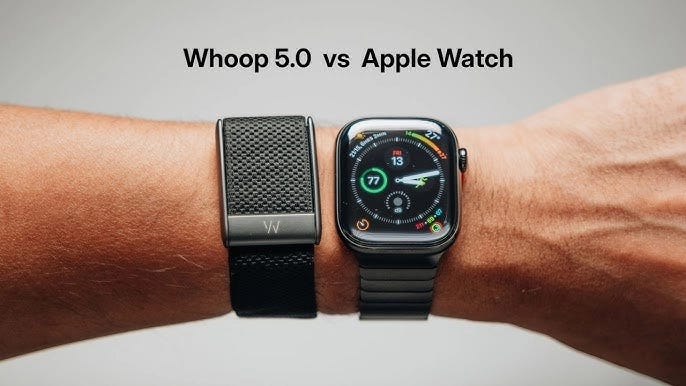
The screenless design is the clearest expression of this. By eliminating the screen, WHOOP gave up notifications, apps, contactless payments, and everything else that makes the Apple Watch a Swiss Army knife. What it gained was longer battery life, a smaller form factor, an “invisible” aesthetic that doesn’t announce itself as a tech device, and complete freedom from the attention economy. WHOOP is never competing for your focus. Instead, it gives you focus. It is only ever in the background, monitoring, accumulating signal.
Data privacy is a second structural advantage. In a landscape where user data is routinely monetised — a practice that notoriously complicated Google’s acquisition of Fitbit and triggered regulatory scrutiny — WHOOP has committed explicitly to not selling customer data to third parties. For health data in particular, that commitment resonates with users in a way that general privacy policies do not.
The third element is a deliberately bifurcated innovation cycle. Hardware roadmaps run three to four years out, placing ambitious bets on unproven technology and giving engineering teams time to solve genuinely hard problems. Software ships on two-week sprint cycles, constantly delivering new value to existing subscribers and giving the team rapid feedback on what’s working. These two clocks serve different purposes and don’t need to be synchronised — a distinction that most hardware companies fail to make clearly.
None of this is replicable by Apple without Apple becoming something it isn’t. That’s the point. The most durable competitive positions aren’t the ones that are hard to attack — they’re the ones that are impossible to attack without self-destruction.
Where It Gets Harder
A clear-eyed read of WHOOP requires naming what the company gets wrong, or what might go wrong — because there are genuine risks that the bullish narrative tends to absorb without accounting for.
Sensor accuracy is still contested. The entire value proposition of Strain and Recovery depends on the heart rate data being reliable. Independent reviewers have found WHOOP’s HR readings inconsistent during exercise — sometimes too high, sometimes too low, and sometimes accurate — a pattern that is arguably more problematic than being consistently wrong, because it makes it harder to know when to trust the data. Oura’s ring-based sensors, sitting closer to the arteries of the finger, have demonstrated a structural signal quality advantage for certain metrics — one that WHOOP cannot easily engineer away from the wrist. For a platform increasingly making clinical-adjacent claims, the measurement layer underneath those claims still has meaningful limitations.
The upgrade backlash was a structural warning, not just a PR problem. The WHOOP 5.0 launch in May 2025 triggered significant consumer backlash — Reddit threads titled “Whoopgate: The Receipts”, Bloomberg coverage of WHOOP “trending for all the wrong reasons” — after the company appeared to contradict its own prior commitments about who qualified for free hardware upgrades. Long-term subscribers who had paid upwards of $800 over four years found themselves potentially ineligible for the upgrade that new customers received immediately upon joining. WHOOP reversed course and issued refunds, but trust issues linger, particularly around transparency. For a business model built entirely on retention economics and community loyalty, this kind of trust erosion matters beyond the PR cycle. The incident revealed a tension that will resurface: as WHOOP segments its product tiers upward and adds premium-only features, it risks alienating the loyal base that built the brand.
The FDA is watching the medical device boundary closely. This is the most significant structural risk and the one most likely to shape WHOOP’s trajectory over the next several years. In July 2025, the FDA issued a warning letter regarding WHOOP’s Blood Pressure Insights feature, concluding it constitutes a medical device based on intended use — estimating blood pressure — and therefore requires premarket authorisation WHOOP had not obtained. That letter anchored a class action lawsuit filed in November 2025, in which plaintiffs alleged consumers paid a premium for features that were not legally marketed, seeking restitution and an injunction against further promotion of the blood pressure functionality. The case is unresolved and the allegations remain unproven. But the underlying tension is very present: the more WHOOP pushes toward clinical-grade claims to justify premium pricing, the more it enters regulated territory — where the rules are different, the timelines are long, and the cost of getting it wrong is material. Becoming a health OS and remaining a consumer wearable are not inherently incompatible, but the path between them runs directly through regulatory approval processes that are slow, uncertain, and expensive.
None of this diminishes what WHOOP has built. But it does reframe the question for anyone thinking about this space seriously: the company’s next chapter is less about whether the platform works, and more about whether it can navigate the transition from performance tool to health infrastructure without losing the trust, focus, and regulatory clarity that got it here.
Conclusion
The WHOOP story is unusually interesting precisely because it is still ongoing. The first chapter — building the technology, seeding the culture, structuring the model — is largely settled. The second chapter is just getting started.
What the next phase tests is whether those same principles hold as WHOOP pushes deeper into clinical territory, where the regulatory environment is less forgiving, the competitive field is broader, and the definition of “performance” is expanding faster than any single company can contain.
Wow, I never thought about the culture reposition to “high-status performing tool” before. What a great connection. However, my mind always goes back to the 1997 theorem No Free Lunch. We are getting all this health data about ourselves but who else is getting it? I fear the stakes might be higher than they are letting on. And the health insurance industry has never been ethical. As you’ve mentioned the FDA does have a lot to think about and will most definitely be shaping WHOOP’s future. Great read!
Such an insightful read! Love it