

"You do not rise to the level of your goals. You fall to the level of your systems"
— James Clear
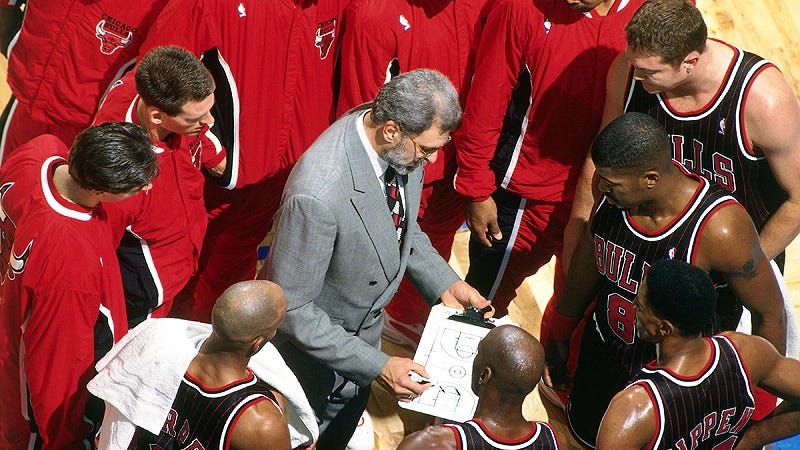
Phil Jackson won 11 NBA championships. He also burned sage in locker rooms, made players read Zen philosophy, and let Dennis Rodman fly to Las Vegas to wrestle mid-season (a special case, I admit). None of that is in any coaching manual, but all of it was deliberate. Jackson wasn’t managing behaviour, he was building rituals that made the mundane sacred and kept ego out of the system.
He’s a good place to start. Because the most durable performers in sports share three things that have nothing to do with talent or tactics: they design environments, not features. They build rituals, not goals. And they measure what compounds, not what flatters.
Design the system, not the feature
When Pep Guardiola took over Manchester City, he didn’t start with tactics. He started with details that seemed minute at the time: how players interacted with each other, how the shape of the dressing room impacted culture, and how video analysis and data were used in the daily routine. No new formation or marquee signing (until later). He first redesigned the environment itself, and elite performance followed.
James Vowles is doing the same thing at Williams Racing, just with higher stakes and a longer timeline. He took over with an explicit mandate to “break everything”. Legacy systems, outdated processes, a culture built on past glory rather than present reality — he’s dismantling all of it, deliberately and without sentiment. He’s implementing new technology stacks, new accountability structures, new ways of working at every level. The early results have been a mixed bag, for sure. But Vowles isn’t building for this season. He’s rebuilding the organisation as a system, and that requires completely breaking it first. That’s a fundamentally different game. Much slower and harder, but the only one worth playing if you want sustained performance rather than a lucky podium.
Both cases tell the same story: durable performance is never the product of a single intervention. It’s what happens when the environment itself is designed to produce it. For a founder, that means asking a harder question than “does this feature work?” It means asking: does our product change the conditions under which the user operates — or does it just add another variable to an underlying system we haven’t touched?
Rituals beat goals
Goals tell people where to go. Rituals get them there, and crucially keep them there when motivation runs out.
Coach Jackson from the example above understood this intuitively, and he built it into the architecture of his teams. His famous Triangle Offense wasn’t just a set of plays drawn on a whiteboard — it was a philosophy encoded as a system, designed to turn five individuals into a single organism reading and reacting in real time. No one player could dominate it. No one player could break it. The system made the collective smarter than any individual within it. Off the court, he reinforced the same logic through ritual: burning sage before games, assigning philosophy texts, giving Rodman permission to miss practice and wrestle in Vegas — because he understood that conformity kills creativity, and that a system capable of holding Dennis Rodman is a system capable of holding anyone. When egos clashed, he benched them. Not the players, the egos. The Triangle didn’t care who you were. It only cared whether you played your role within it.
The New Zealand All Blacks built something similar, and they put it in simpler terms: “Sweep the sheds.” After every match, all players (including the most senior) clean the locker room. This is not about hygiene. It’s about ego. A signal, repeated until it becomes reflex, that no one on the team is above the work. No task is ever beneath you. Over time, the behaviour became so embedded it stopped needing enforcement. It just was what the All Blacks did.
For a product builder, the implication is direct: make the key behaviour the default. Give it a clear cue, a cadence, and a defined recovery path for when someone slips. A goal tells your user what they should do. A ritual is what your product does when they don’t feel like it.
Measure what compounds, not what flatters
Sir Dave Brailsford built British Cycling around a deceptively simple idea he called the aggregation of marginal gains: find every variable that affects performance, improve each one by 1%, and let the compounding do the work. Redesign the bike seat. Test fabrics in wind tunnels. Teach riders the optimal way to wash their hands to reduce illness. Individually, none of it moves the needle. Collectively, it moved the entire sport. Critics thought he was insane. Then British Cycling dominated the Olympics and the Tour de France. For a decade.
The insight wasn’t that any single optimisation mattered. It was that the critics were measuring the wrong things — evaluating each intervention in isolation, asking whether this or that change made a difference. Brailsford was measuring what happened when everything compounded. The aggregate. The system-level output over time. That’s a completely different question, and it requires completely different metrics to answer it. The 1% gains only work if you’re tracking the sum, not the parts.
For companies building in performance and health, this cuts directly against how most products are evaluated. Biomechanics, load management, VO2 max — undoubtedly useful, but they measure the variable, not the system. Adherence, engagement, time-to-value are harder to report on, but actually tell you whether your product is working.
So what?
The leaders in these examples share one insight: you can’t isolate and optimise variables independently. Everything interacts. Sleep affects training. Training affects recovery. Recovery affects cognition. Cognition affects culture. Culture affects everything.
The companies that understand this — that build products treating humans as complex adaptive systems rather than machines to be tuned — will win. In the era of AI, that distinction matters more than ever.
The hardest problems in human performance aren’t technical. They’re environmental, ritual, and cumulative. The best founders aren’t solving for the motivated user on their best day. They’re building systems that hold on the average Tuesday, when no one feels like it and the habit still needs to hold.
At Momentous, we back founders who understand this, and build accordingly.