

The Sydney Sweeney x Novig ad which we’ve all been arguing about was a decoy. Let’s put our different views aside and take a look at what Novig actually is, what the company does, and how it is (negatively) impacting people.
Just in case you haven’t seen this ad, here’s a quick TLDR: In early September, Novig ran its first national advertising campaign which was designed to provoke, polarise, and go viral. It featured Sydney Sweeney, nude, holding sporting equipment in strategically placed positions. Throughout the ad she simply repeats the messaging around Novig being about “Just Sports”.

On 11 October, Sweeney doubled down and posted a new commercial from the same campaign. The polarisation continued, but the whole argument remained about her body. Almost nobody looked at what she was actually selling despite the fact that viewership skyrocketed.
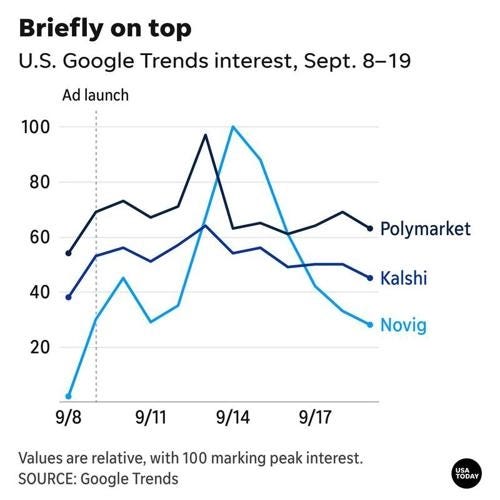
Novig — which is a sports betting platform — made a calculated move which paid off handsomely. In the 20 days either side of the launch, Novig’s trading volume rose by nearly 94% and first-time depositors by more than 218%, according to co-founder Jacob Fortinsky.
While all the outrage and debate was centred on Sweeney, nobody seemed to be bothered about the nature of the Novig platform itself.
Novig belongs to a family of platforms that has absolutely nothing to do with sports.
** Kalshi and Polymarket have entered the chat **
Each of them have repackaged betting with some sleek wording and put it behind an interface so alluring that it stops feeling like a dangerous financial product. Each of them also earns the most from the customers with the least room to lose, and that is the real outrage here.
Just sports? Not in the slightest.
The clever rename
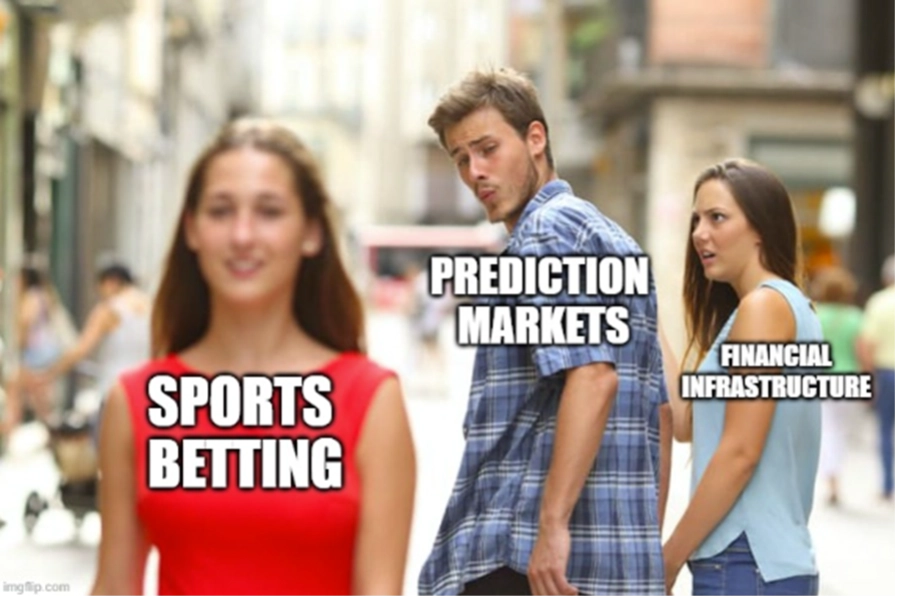
The betting industry begins by renaming the transaction in exactly the same way the borrowing industry did. Betting becomes trading or “predicting”. Borrowing becomes paying in four instalments or “buy now pay later (BNPL)”.
And the new language really does some heavy lifting to bamboozle the customer. In one national poll, 73% of Americans said terms like “event contracts”, “swaps” or “futures” make it harder for people, especially young men in this case, to recognise the financial risks.
BNPL users fall for the same trick. In the Federal Reserve’s 2025 household survey, 53% of BNPL users wrongly believed that paying on time would help their credit score. It doesn’t, because most BNPL lenders don’t report these loans to the credit agencies.
The new name also decides who regulates. Britain’s FCA only began regulating BNPL on 15 July 2026, and loans offered directly by merchants are still exempt. In the US, the CFPB withdrew a rule that had treated many BNPL services like credit cards. Novig made the same move for betting. Its CFTC approval lets it bypass state-by-state sportsbook licensing, along with the consumer protections that come with it.
Who’s actually using it?
BNPL was sold as a way to spread the cost of a new jacket or an iPhone Duo for example. However, as it turns out the people using it most are the ones with the least in reserve. 31% of US adults with under $100 in savings used BNPL last year, compared with 8% of those with $2,000 or more. Lower-income users are also far more likely to use it for groceries.
Britain looks the same. 10.9 million UK adults used BNPL in the year to May 2024, and use was highest among people with low financial resilience and those in the most deprived areas.
Prediction markets recruit along exactly the same line. 53% of users said they started for income-related reasons. And Bank of America has warned that the fallout will hit low-income consumers hardest… which brings me to my next point.
Who pays the price?
Somebody always pays in the end. On a prediction market, it’s the retail user. Even Kalshi acknowledges that the majority of users on its platform lose money. The Roosevelt Institute estimates that retail traders on Kalshi have lost $583.5 million since launch, $371.6 million of it on sports.
Novig’s pitch is that removing the house makes the game fair.
Well… not quite. It simply moves the winnings from the operator to whoever is sharp enough to take the other side. On Polymarket, 68.8% of users lost money, while the top 1% took 76.5% of all profits. Casual fans provide the liquidity, while the professionals are on hand to rake it in.
Many of the users are betting money they don’t have. In one survey, half of prediction market users had borrowed to place bets, and 88% of those borrowers lost.
Beyond the financial cost, gambling counsellors report clients who had self-excluded from sportsbooks relapsing on prediction markets, which conveniently sidestep state consumer protections as they use specific business models and legal arguments to place themselves under federal financial laws rather than state gambling laws. UCLA’s Gambling Studies programme has seen more people coming into treatment, and for many of them a prediction market was their first experience of gambling. Kalshi and Polymarket accept users from 18, while most US sportsbooks require 21. Novig, to its credit, unlike Kalshi and Polymarket, requires users to be 21 or over.
We already know where this ends. A UCLA-led study found bankruptcies rose 28% in US states that legalised sports betting.
BNPL works the same way, just more quietly. Klarna earned $284 million in interest in the first quarter of 2026, more than a quarter of its revenue, for a company known for 0% instalments. To be fair, much of that comes from Fair Financing, its openly interest-bearing loans. But that’s the model: the free product brings customers in, and the paid products earn from them later. And the fees land on those with the least. 18% of BNPL users with under $100 in savings had a payment trigger an overdraft fee, compared with 4% of those with $2,000 or more.
Why Momentous stays out
The Sweeney campaign showed where people put their attention. By any measure, it was an immensely successful ad that delivered on what it was designed to do. But the debate stayed at the surface and completely ignored the underlying platform.
Betting and borrowing platforms have built huge businesses whose revenues grow as their users’ wellbeing deteriorates. That makes it even more surprising who is lending them their names.
Sweeney isn’t alone. LeBron James announced a partnership with Polymarket in September, having previously appeared in DraftKings ads. Kevin Durant is invested in Kalshi through 35V, the venture fund he co-founded with his agent Rich Kleiman. Kalshi has also signed up Lionel Messi through a partnership with Argentina’s football association, and Luka Modrić through Croatia’s. These athletes built their careers on discipline, longevity and looking after their physical and mental state. Now they are the faces of products that profit when their fans lose control…
Momentous doesn’t invest in gambling, and prediction markets fall inside that line. The same logic rules out consumer products whose revenue depends on users falling behind. The Human Potential Stack backs products that succeed when the user gets measurably better. Sleeping, recovering and performing better, and living longer in good health. Betting and BNPL both run the incentive the other way. The most valuable customer is the one who keeps playing, or keeps paying late.