

Nike.
Just do it.
This was one of the most iconic slogans that I grew up with. One that many of us came to see as synonymous with mastery, excellence and victory. I don’t have to tell you about Nike’s generational run (no pun intended) in the 90s and 2000s, aligning itself with the absolute best of the best in the game.
Michael Jordan (whose partnership of course turned into the legendary Air Jordan brand). Cristiano Ronaldo. Kobe Bryant. Roger Federer (before they fumbled it and let him go to Uniqlo and On). Serena Williams. Tiger Woods. And many many others.
If you’d asked me 15 years ago, I would have told you that I will never wear a pair of football boots other than the Nike Mercurial line up. Putting these boots on before training sessions, or an important match, made me aspire to lock in and play like the greats that I looked up to.
I even used the Nike tracker which elegantly paired with my iPod Touch at the time to track my runs. For everything Nike sells today, let’s not forget they started as a high quality track shoe brand. And this tracker was another example of Nike pushing their market leadership to new heights. If you look at the tech we use to track our runs today, you truly notice how far ahead of its time this clever little motion tracking device was. It was released way back in 2006!
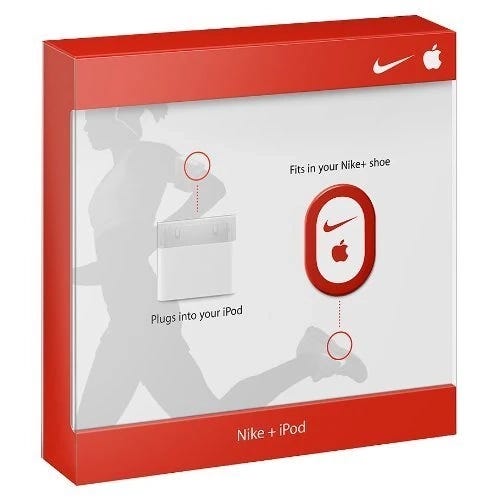
Anyway, as you can tell by the title of this piece, somewhere along the way Nike just… stopped doing it.
As of today, Nike is no longer part of the S&P 100, a position it has held for nearly 18 years. Its stock has plummeted roughly 78% from its 2021 peak, shedding $220B in market value. Over the same five years the S&P 100 climbed about 83%. Ouch.
Even though the company seems focused on making a comeback, it’s hard to see how they will succeed at that with incumbent and new gen competition from Hoka, Adidas, Brooks, On, and others.
This piece looks at how a company with that much cultural equity — Nike is literally named after the Greek goddess of victory — let its own moat wash out from under it, and whether it can find its way back.
It lost the shelf
The most consequential decision Nike made this decade was to bet everything on selling directly to the consumer. Even though their wholesale B2B2C strategy is what led to its market leadership in the first place.
On paper it made sense. Sell through Nike’s own stores, app and website, and the company keeps more margin, owns the customer data and controls the whole experience end to end. Why let a retailer stand between Nike and the person buying the shoe, right?
Beginning in 2020, Nike cut its wholesale accounts by more than half, concentrating on roughly 40 key partners plus its own ecosystem. It exited Amazon entirely in 2019 over brand-control concerns, and walked away from DSW and, for a period, Urban Outfitters.
The problem is that Nike confused owning the channel with owning demand. Shelf space doesn’t sit empty waiting for you to come back. Lo and behold, as Nike pulled out, New Balance, On and Hoka filled the gap it left behind.
The reset since has been comprehensive, and Elliott Hill (who was re-appointed CEO in 2024, after an initial 32-year stint that ended in 2020) has made rebuilding these relationships his first priority. Nike relaunched on Amazon in autumn 2025 after a six-year absence. In the fourth quarter of fiscal 2026, wholesale revenue grew 4% to $6.6bn, led by North America, even as Nike Direct and Digitial keep sliding.
Ironically, the channel Nike spent five years dismantling is the one leading the recovery charge, and the channel built to replace it is still shrinking.
It lost the ground
Nike’s challengers didn’t overtake it by getting bigger overnight. They took one channel at a time, starting with the specialty running shop — the place staff actually know what they’re talking about.
Foot Locker, once nearly 75% reliant on Nike for footwear, started handing both brands more wall space as it diversified away from a single supplier — adding 10 million new US customers through rising brands like On and Hoka in a single year, with comparable sales of non-Nike product growing around 30% in quarters when Nike-branded comps fell. On alone grew its US store count 15% and its wholesale revenue 73% in that stretch, while Hoka’s own wholesale push helped drive net sales up more than 90% year-on-year at Deckers.
That early foothold compounded. Hoka grew sales 16% in fiscal 2026 to $2.6B, now accounting for almost half of parent company Deckers’ total revenue. JPMorgan’s Matthew Boss, in the note that took his Nike rating to Underweight in August, pointed out that On and Hoka have closed their combined market-share gap to Nike from a ten-point advantage down to roughly 200 basis points.
The two brands that were rounding errors in 2019 now sit within two percentage points of the company that defined the category.
That same drift is visible in who’s forming brand loyalty for the first time. Nike’s footwear mindshare among US teenagers averaged around 60% across 2022 and 2023. By spring 2025 it had fallen to 49%, and by autumn to 46%.
Running is the category that will sting the most. Nike spent years chasing the sub-two-hour marathon barrier as the sport’s ultimate proof point — Breaking2 in 2017, a purpose-built project still left Eliud Kipchoge an agonising 26 seconds short. A second funded attempt in 2019 got him under two hours, but not on a record-eligible course…
Nobody did it for real until the 2026 London Marathon, when Sabastian Sawe crossed the line in 1:59:30 — the first sub-two-hour marathon ever run under record-eligible conditions.
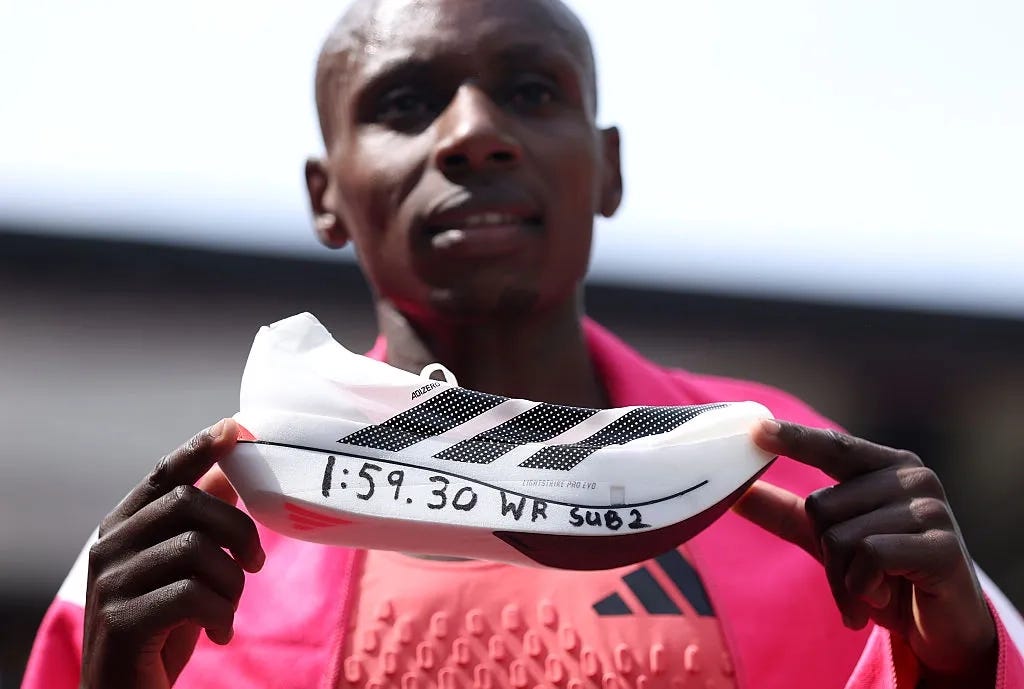
He was in Adidas. So was runner-up Yomif Kejelcha (1:59:41) and Tigst Assefa (2:15:41), who broke the women’s world record in the same race. The record Nike spent a decade trying to own was finally broken — by three athletes wearing Adidas. Ouch.
The football World Cup drove the same point home on the biggest stage. Adidas sponsored 14 national teams to Nike’s 12, and none of Nike’s teams — including semi-finalists England and France — reached the final. Adidas dressed both Argentina and Spain, its share of the US footwear market rising to 19.2% in June 2026 from 16.0% a year earlier. Despite Nike’s own viral marketing push during the tournament, Adidas won the ball, the referees’ kit, both finalists and the trophy. Aka the things that actually matter for a sports brand.
The pressure isn’t only coming from Adidas though. On announced on Friday that it’s entering football outright, headlined by Kylian Mbappé — who left Nike after 20 years (sponsored since he was eight) to become the face of On’s new football category, in a deal that includes an equity stake rather than a standard boot contract.
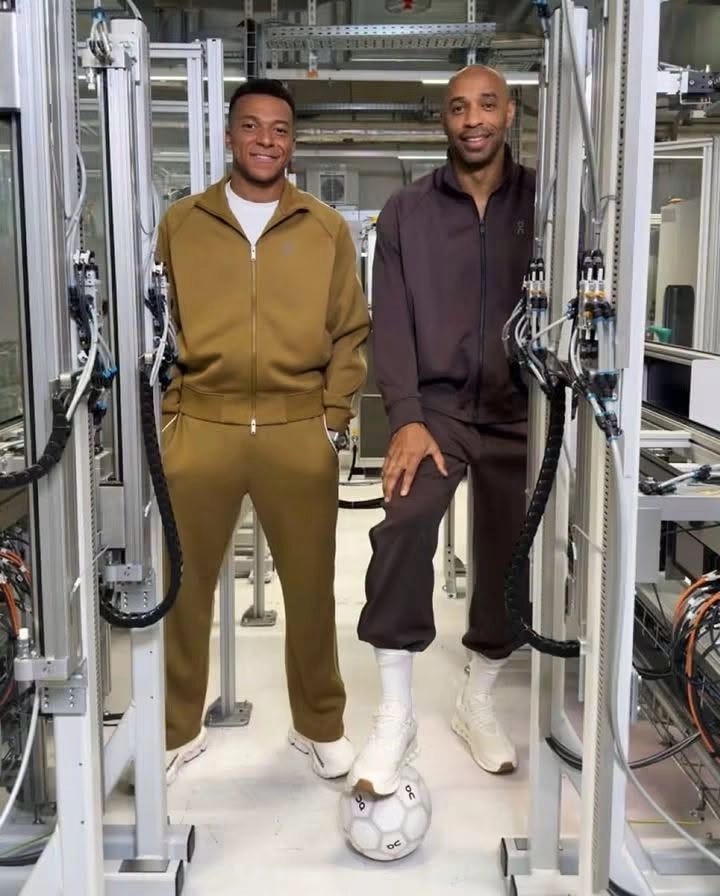
Thierry Henry, who’s been building the division quietly since late 2025, is now On’s director of football. The first boots won’t ship until 2027, but the message landed immediately: the same athlete who fronted Nike’s World Cup campaign a few months ago is now betting his own equity on the challenger brand working to unseat it.
It lost the experts
Brand marketing doesn’t show results for years, and even then it’s difficult to attribute them cleanly. Performance marketing on the other hand gives you a clear number by Friday. After years of success with the former, Nike switched its strategy to simply focus on the latter.
In 2020, under then-CEO John Donahoe, Nike dismantled its category-led structure — teams built around running, football, basketball and training — and replaced it with three broad buckets: women, men, and kids. Hundreds of people with decades of sport-specific knowledge left within six months, taking their expertise with them. There was no longer a team whose entire job was asking what an elite marathoner actually needs, or what a first boot for a youth footballer should feel like. There was a gender bucket, and a data-driven “flywheel” that was supposed to answer those questions instead. But it diluted Nike’s positioning as the expert.
Performance marketing looks brilliant for a while, because it’s spending brand equity someone built up and paid for years earlier. The ROI holds right up until that equity runs out, then ROI and demand fall off together. Nike thought it was measuring a new strategy working, though in reality it was just cashing in on the old one.
Some of that borrowed equity came from leaning harder into political and social statements than the brand ever had before, Kaepernick’s 2018 campaign chief among them. The short-term payoff was real — online sales jumped over 20% within days, and the stock hit an all-time high within two weeks. But the more the brand spoke as a political actor rather than a sporting one, the less it sounded like the company that made you believe you could play like the greats. That’s borrowed equity too, and it once again chipped away at Nike’s positioning.
The identity gradually went missing, and “Just Do It” became an empty slogan instead of a way of life. Hill seems to know this, which is presumably why they re-appointed him. At Nike’s annual meeting on 8 September, he said the company wouldn’t manage itself quarter to quarter, and that it needed to put the athlete back at the centre of everything it does.
It lost the product story
The final issue is quality.
When people say Nike’s quality dropped, they usually mean stitching, materials, and durability in individual products which have been letting people down in recent years. But the bigger decline sits one level up: quality of the decisions about what to make next.
Nike used to ship innovative products that pushed their category forward — Air Max, Flyknit, Mercurial, the Nike+ partnership, Vaporfly. These forced competitors to react and gave Nike’s marketing something true to shout about. But that gradually changed, and for too long the company has leaned on iterations, retros and safe extensions of franchises that had already worked once before. Air Force 1, Air Jordan 1 and Dunk grew into three of the industry’s biggest multibillion-dollar franchises this way — and Nike oversupplied all three chasing that growth, diluting the exclusivity that made them desirable in the first place. Even after cutting back, the company was reportedly still making more of them than it could sell.
That reliance shows up in the numbers. Nike Sportswear and Jordan Streetwear together make up roughly half of total revenue — and growth across both is expected to stay negative through the first half of fiscal 2027, as the same retro-heavy assortment that built them stops pulling its weight with customers.
The correction is under way. Hill has promised more than a dozen new footwear styles for the second half of fiscal 2027 — new silhouettes, not rehashes. It’s already showing where it matters: Nike running is up double digits for five straight quarters, adding roughly $1bn — proof the one category that never stopped innovating is recovering fastest because of it. But one bright spot doesn’t offset a wider retreat. Greater China is now down for eight straight quarters, with digital sales there off 29%.
What now?
Recovery at the level of the business isn’t really in doubt. Nike, though in a tough spot, is still one of the industry’s heavyweights. And who doesn’t love a comeback story!
What’s disputed is the timeline. Bernstein has an Outperform rating and a $72 target, arguing margins recover ahead of revenue as clearance inventory clears. JPMorgan cut Nike to Underweight in August with a $40 target, pointing to a China reset and tariff-driven cost pressure through fiscal 2028 — Greater China sales have now fallen for eight straight quarters, with digital sales there down 29%. Both banks are reading the same quarterly results and landing in opposite places, which tells you how complex this recovery process will be.
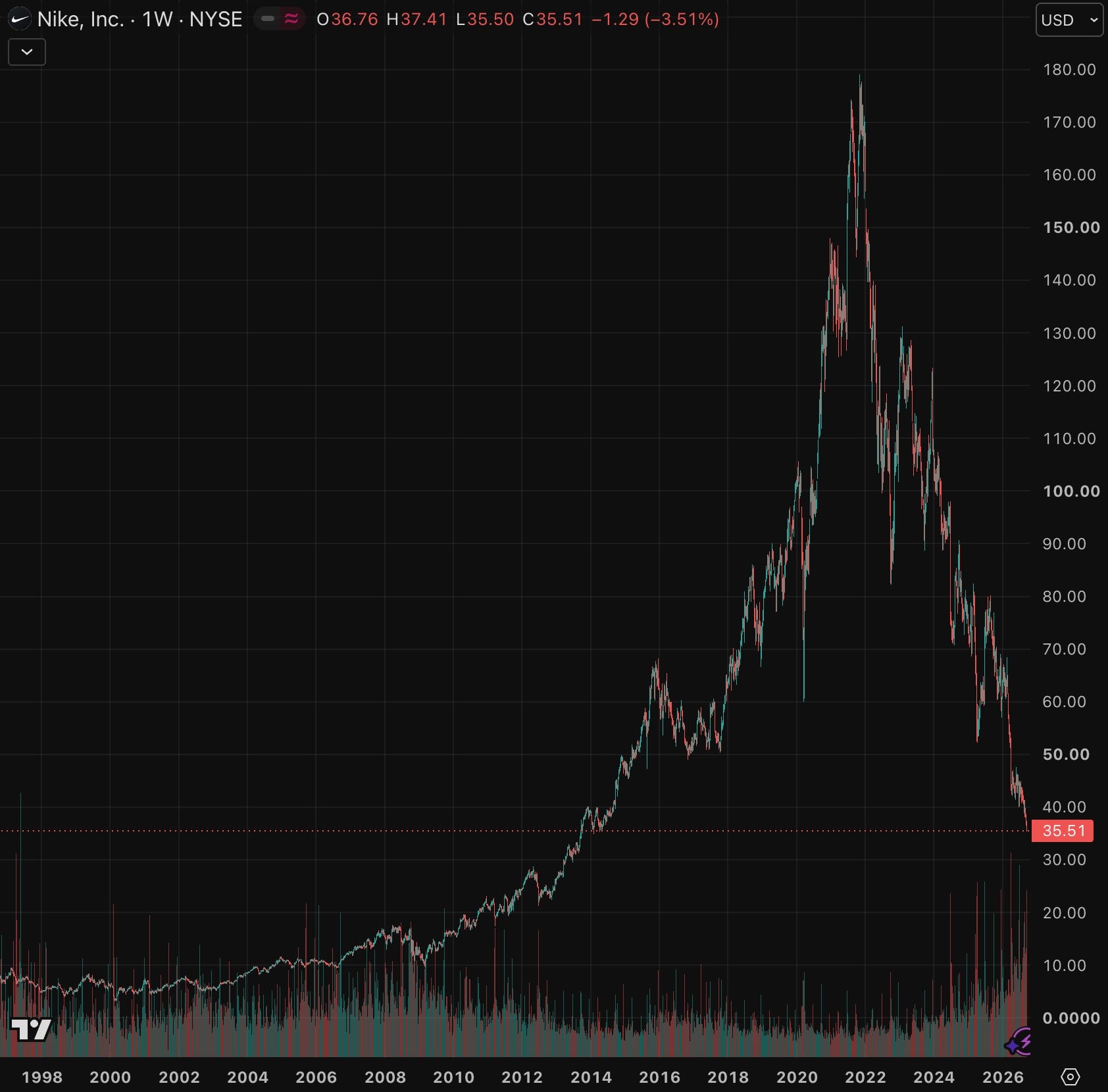
But the stock isn’t really the story here. The story is what Nike forgot along the way.
Every section of this piece really covers the same mistake in a slightly different form. Nike stopped asking what job it was actually being hired to do. Its job is not to “sell shoes.” But something closer to: make someone feel one step closer to the athlete they admire.
That’s what a pair of Mercurials did for me before a match. What a specialist running shop did for someone training for their first marathon. What “Just Do It” meant a long time ago, before it became just an empty slogan. You can see that job and identity getting lost in every decision covered here. Nike pulled back from the retailers that understood it better than the Nike app did, then watched Hoka and On take the wall space. It reorganised around gender instead of sport, losing the teams whose whole purpose was to understand what each customer from the beginner to the endurance athlete actually needed. Instead it leaned on existing Jordans and Dunks because they were easier to sell than developing the next real innovation. All of this has compounded in a negative way, from the record it lost at the marathon to the athlete it lost to On.
Hill’s language suggests he is firmly in charge of the turnaround story. Putting the athlete “back at the centre of everything” is really a promise to remember what Nike stands for.
It’s also the question worth asking about every company long before it even needs a comeback: what job is the person on the other side of the purchase hiring you to do? And is what you’re building still doing it, or have you unconsciously started optimising around it instead?
In a sea of people talking about only ads, creative and socials, it’s so refreshing to see this case study about how powerful distribution is as a reminder that marketing was never just about ‘promotion’ but all the 4Ps!
Great read!
Something tells me that this is just a dip. The move to go DTC was a mistake of catastrophic magnitudes. The consequences have been compounding, but I think if they get back to the basics, they'll be okay in the end. It took a lot for Adidas to reach this point.