

Every wearable on the market today does the same fundamental thing: it watches you, then reports back. A ring or a wristband can tell you, the next morning, that you slept badly. While it can give you recommendations on how to improve your sleep, performance, and overall health, it ultimately has no agency to do anything about it. Eight Sleep was built on a different premise entirely — that the most valuable health device isn’t the one that watches, but the one that intervenes. A thermostat with a mind of its own, working on you while you’re unconscious.
Matteo Franceschetti arrived at that premise the long way. A former lawyer and competitive athlete, he became fixated on a simple, uncomfortable fact: he spent a third of his life in an environment he had no control over, and that environment was working against him. The founding insight wasn’t complex, but it required looking directly at what the mattress industry had spent decades ignoring: temperature is the primary biological driver of sleep quality, and nobody was actively managing it. The body needs to drop its core temperature to initiate sleep, and to cycle through specific thermal ranges to move between deep sleep, REM, and lighter stages. A standard, static foam rectangle, heated by body mass all night, does the opposite of what the body actually needs. Franceschetti partnered with engineer Massimo Bassi and PR strategist Alexandra Zatarain, and after an initial rejection from Y Combinator, famously returned to build a fully functional bedroom inside the YC interview room and secured admission the second time of asking.
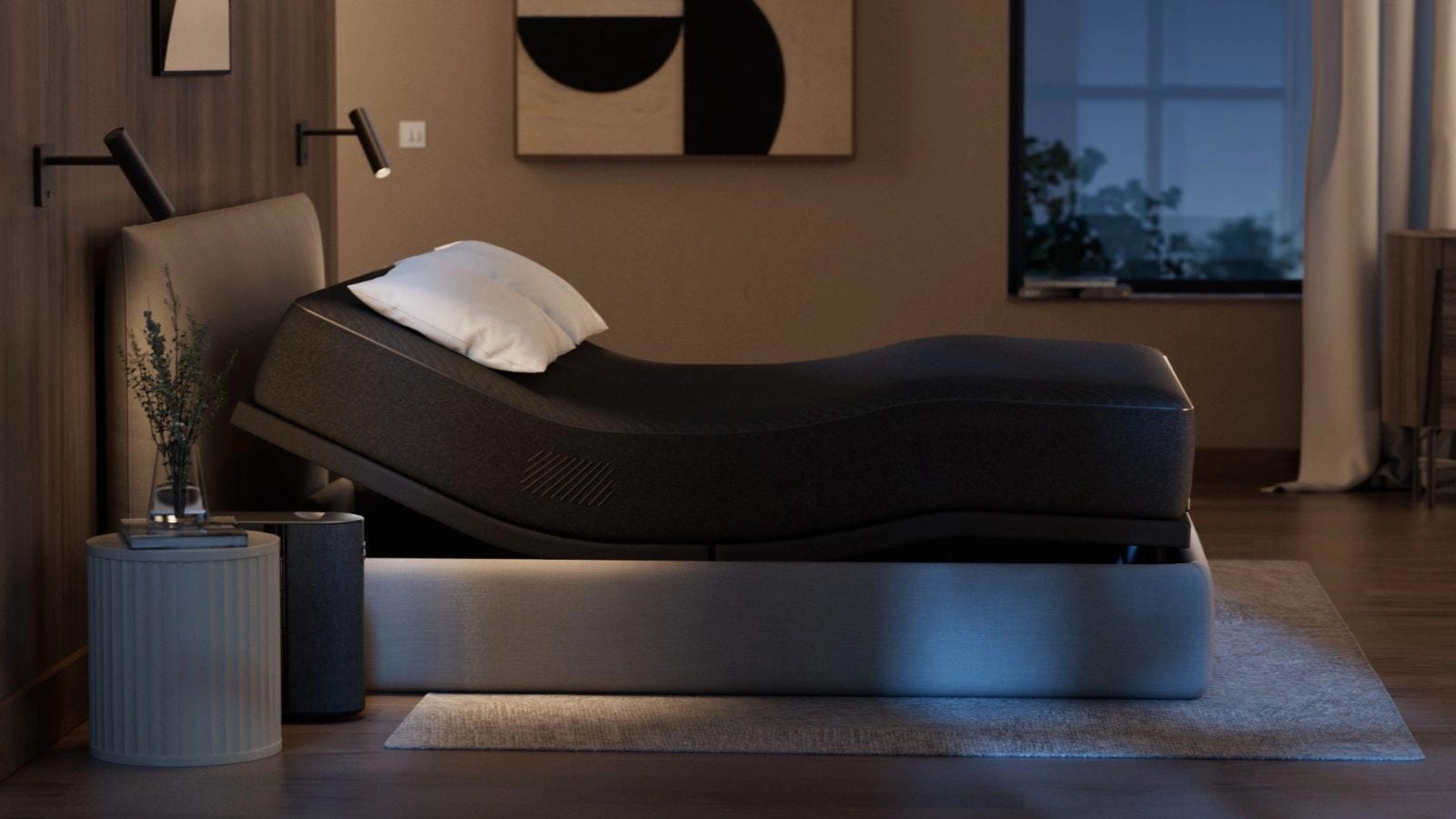
Today, Eight Sleep operates at institutional scale. The Pod has surpassed $500 million in cumulative sales, with revenue growing tenfold since its introduction. In March 2026, a $50 million strategic round led by Tether Investments valued the company at $1.5 billion, up from $1 billion in August 2025, and $500 million at its Series C in 2021. Total funding raised stands at over $310 million. The company reached free cash flow positivity in 2025 and now ships to 34 countries. Eight Sleep is no longer a hardware startup. It is in the process of becoming something considerably more consequential: a predictive health intelligence platform anchored in the bedroom.
Hardware as a Clinical Lab
Eight Sleep confronted hardware risk first. Before there was a product worth selling, there was a genuinely difficult engineering problem: building a system capable of pumping water through a mattress cover continuously, without leaking, without failing under human body weight, and without disturbing the sleep it was designed to improve. There was no question of whether people wanted to sleep better. The open question was whether the company could build a physical system precise enough to validate the underlying science in the first place.
Validating that science required clinical investment. Eight Sleep embedded sensors across the Pod cover to continuously track heart rate, respiratory rate, and heart rate variability (HRV), without requiring the user to wear anything. An early peer-reviewed study of 54 participants crucially demonstrated that the Pod increased deep sleep by 14 minutes and REM sleep by 9 minutes in specific cohorts, lowered resting heart rate by two percent, and increased HRV by seven percent. These were the foundation on which everything else was built.
The intended outcome of that investment was verifiable sleep improvement. The unintended outcome was vastly more valuable. By occupying a permanent position in the bedroom, Eight Sleep created a continuous health data collection system that operates every night, without friction, without compliance decay, and without the user having to remember to wear a device. The company now trains its predictive models on over one billion hours of real-world sleep data. That dataset is not the product of a research study. It is the compounding result of a thoughtful consumer hardware business.
Building physical products is the required path to capture proprietary longitudinal biological data.
Rest as Athletic Performance
Eight Sleep didn’t just need to sell an expensive mattress cover. It needed to make spending thousands of dollars on a mattress cover feel rational (aspirational, even). That required a cultural reframe that reached far beyond any simple marketing campaign.
The company identified its entry point precisely. High-performers, elite athletes, and biohackers were the required early adopters — because of their spending power, but more importantly because of the cultural signal they carried. These were people who already tracked their nutrition, their training load, and their recovery metrics. Sleep, in their context, wasn’t a by product — it was the most underoptimised variable in an already-optimised system. Eight Sleep adopted the language of sleep fitness, positioning the Pod as a performance tool rather than another rectangle of expensive foam.
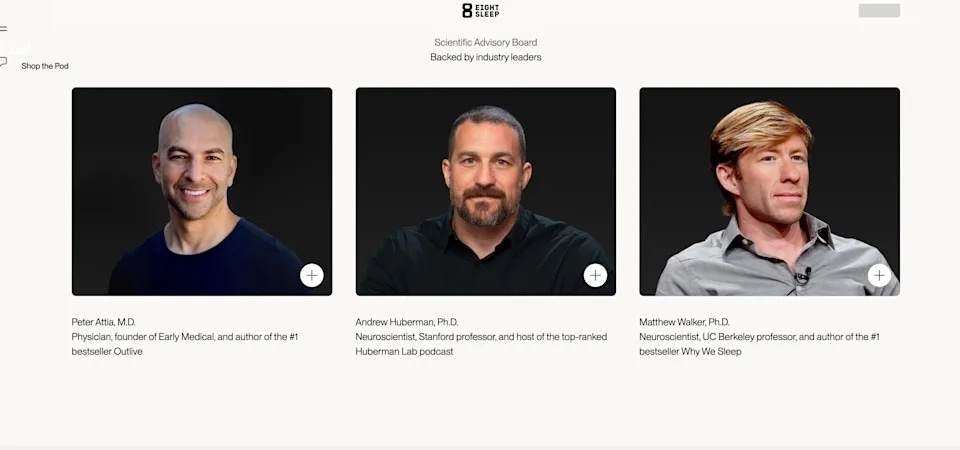
The credibility was built deliberately. Neuroscientist Dr. Andrew Huberman, sleep researcher Dr. Matthew Walker, and physician Peter Attia joined the Scientific Advisory Board, anchoring the platform’s claims in scientific legitimacy (though the latter has since been removed due to his name’s repeated appearance in the Epstein files). Top tech executives including Elon Musk and Mark Zuckerberg also adopted the product publicly which did a lot for the brand. Today, Eight Sleep has built a high calibre roster of more than 300 professional athletes who use the Pod for recovery, including Lewis Hamilton, NBA forward Jimmy Butler, and Yankees outfielder Aaron Judge.
Meanwhile F1 driver Charles Leclerc and tennis player Taylor Fritz both joined as athlete ambassadors and investors, putting their own capital behind the product they use nightly. Bryan Johnson, whose extreme longevity routines attract outsized media attention, equally made Eight Sleep a visible fixture in his regimen.
Each of these associations served a dual purpose.
Functionally, elite users created a brutal feedback environment — people whose performance depends on genuine physiological edge don’t stay loyal to products that don’t deliver. Their continued advocacy was a form of invaluable product validation.
Culturally, they repositioned the category entirely. Once the Pod sat in the bedroom of a Formula 1 driver and a Silicon Valley billionaire, the question of whether the price was justified shifted from financial to aspirational.
Category creation requires identifying the most demanding users and making their obsession aspirational. Nail that and the awareness naturally follows.
Paying for the Pod Twice: Hardware and Subscription Economics
Eight Sleep generates revenue through a model that many consumer hardware companies have attempted and few have executed cleanly. A high-margin upfront hardware sale paired with a recurring software subscription.
The base product is the Pod Cover, starting at approximately $2,000. The full mattress system (the cover plus Eight Sleep’s own foundation) pushes past $3,000. The Pod 5 Ultra, launched in May 2025 as the flagship configuration with an adjustable base enabling automatic head elevation and a hydro-powered blanket, starts above $5,800.
Beyond the hardware, customers are required to subscribe to Autopilot — the software layer that enables automatic temperature adjustments, biometric tracking, and AI-driven sleep coaching — at $17, $25, or $33 per month depending on the tier. Note that the subscription is not optional. Access to the full functionality of the hardware depends on it.
Adjacent revenue streams further extend the ecosystem. The hydro-powered blanket and a temperature-controlled pillow cover each retail at roughly $1,000. The company is also testing a line of sleep-supporting supplements, a move that signals a broader ambition to own more of the user’s sleep-adjacent spending.
Speccing out the product with all the bells and whistles will take the price well over $7,000.
A bargain.
As you may have guessed, the subscription model is not well received. Users routinely raise the question of paying monthly fees to access hardware they have already purchased outright. The dependency on cloud infrastructure has produced real operational exposure: an AWS outage in October 2025 left Eight Sleep devices stuck wherever they happened to be when the outage hit — some users’ beds locked at 43°C, others stranded in inclined positions, with no way to adjust temperature or flatten the base. Eight Sleep shipped an offline Bluetooth “outage mode” shortly after, but the incident exposed the brutal reality that a physical product costing upwards of $2,000 had no functioning manual fallback.
Mandatory subscriptions on physical goods generate the capital and cash flow required to scale hardware businesses and develop AI capabilities. They also generate consumer friction.
The Real Value Exchange
Nobody buys an Eight Sleep Pod because they want a mattress cover. Certainly not at that price. Understanding what they are actually purchasing requires looking past the feature list.
The first thing couples buy is the elimination of thermal conflict. The Pod’s dual-zone architecture allows each side of the bed to operate at a completely independent temperature — one partner sleeping cool while the other sleeps warm. For the significant portion of couples whose sleep is disrupted by temperature disagreement, this is a solution to a critical problem, and it makes the individual purchase decision a shared one.
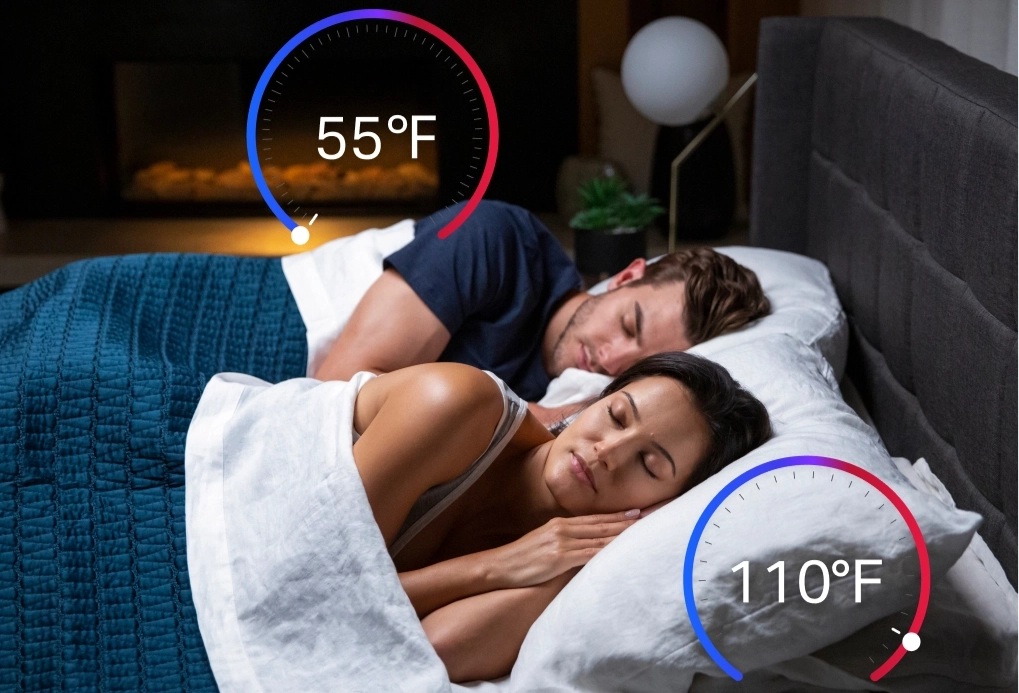
The second thing users buy is unconscious intervention. Autopilot adjusts temperature dozens of times per night based on real-time biometric data, moving through programmed thermal profiles calibrated to the user’s sleep stages without requiring any conscious input. The Pod 5 Ultra adds a further layer: when the system’s acoustic sensors detect the signature of snoring, the base automatically elevates the head to open the airway. The user wakes up having been intervened upon without being aware of it.
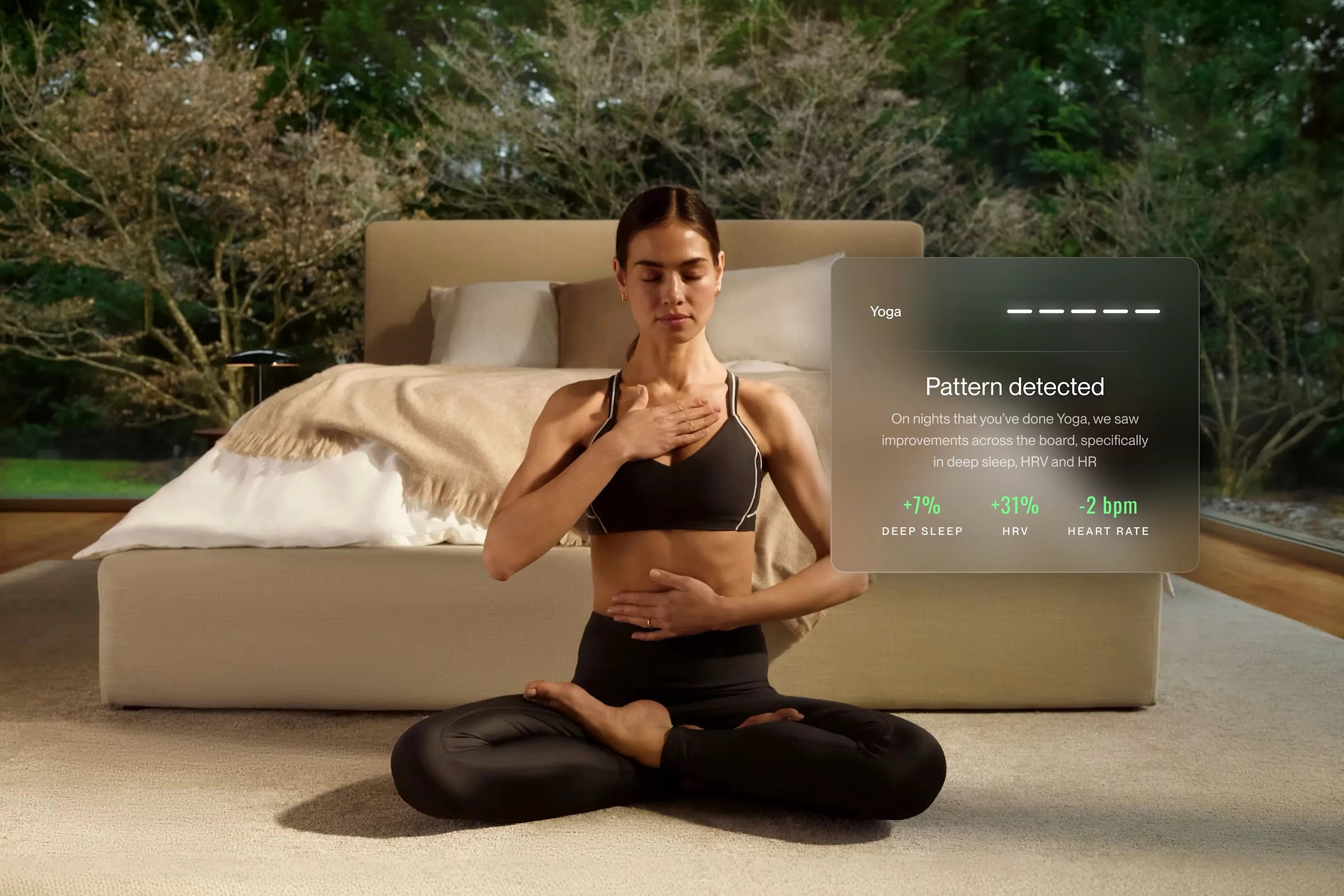
The third is frictionless data synthesis. The Pod tracks heart rate, HRV, and respiratory rate every night, building a longitudinal picture of physiological state without requiring the user to wear anything. For users who find wearables disruptive to sleep (or who simply don’t want yet another subscription device) the passivity of data capture is a meaningful differentiator.
Reviewers consistently describe the same experience: sleeping in a hotel after adapting to the Pod is miserable. The contrast with a static foam mattress, once experienced, is difficult to un-experience. Physical dependence of this kind is the strongest retention mechanic in consumer hardware. When the absence of the product causes physical discomfort, you know you’re onto something.
Retention Carries the Entire Model
Eight Sleep reached free cash flow positivity in 2025, a milestone tied to its refusal to compete on price. Gross margins are strong, and the company reports positive contribution margins on the hardware itself, before factoring in subscription revenue. This means the payback period on customer acquisition cost is effectively zero at point of sale, with every month generating subsequent high-margin subscription revenue against no incremental cost.
That model only holds if retention holds. Thirty percent of Eight Sleep’s revenue now comes from word-of-mouth referrals — a figure that indicates both genuine product satisfaction and an identity-driven evangelism among users who have made the Pod part of how they describe themselves. This organic flywheel lowers blended customer acquisition costs materially over time.
Structural churn risks exist in both directions. Earlier hardware generations suffered from water leaks — a failure mode that destroyed consumer trust and generated documented complaints about hydrogen peroxide residue forming under the cover. App redesigns have periodically forced users to relearn interfaces, introducing friction into a product that derives much of its value from invisibility. However, the dynamic most capable of undermining the model at scale is hardware decay. If the water pump infrastructure fails before the subscription lifetime value has matured, the replacement cost economics deteriorate significantly. The longevity of the physical hardware is not yet a known quantity.
Competing Without Fighting the Foam Wars
The competitive landscape splits cleanly once you set aside the legacy mattress industry. Tempur-Sealy and Serta-Simmons compete on brand awareness, retail distribution, and passive material technology — none of which matters against a software-driven thermal regulation platform, so they’re not really running the same race. The more relevant competitors are companies such as Sleepme, whose Dock Pro system offers water-cooled solutions at lower price points, and Sleep Number, which sells adjustable firmness with basic temperature controls. More recent entrants include Freshbed and Orion who offer very similar propositions.
Wearable companies (Oura, WHOOP, Garmin,…) compete for a different layer entirely. They measure biology and recommend behaviour changes, but they cannot physically intervene while the user is unconscious. Eight Sleep doesn’t just observe the body’s state. It manipulates the environment in real time based on that observation, creating a feedback loop no existing wearable can replicate from the wrist or finger.
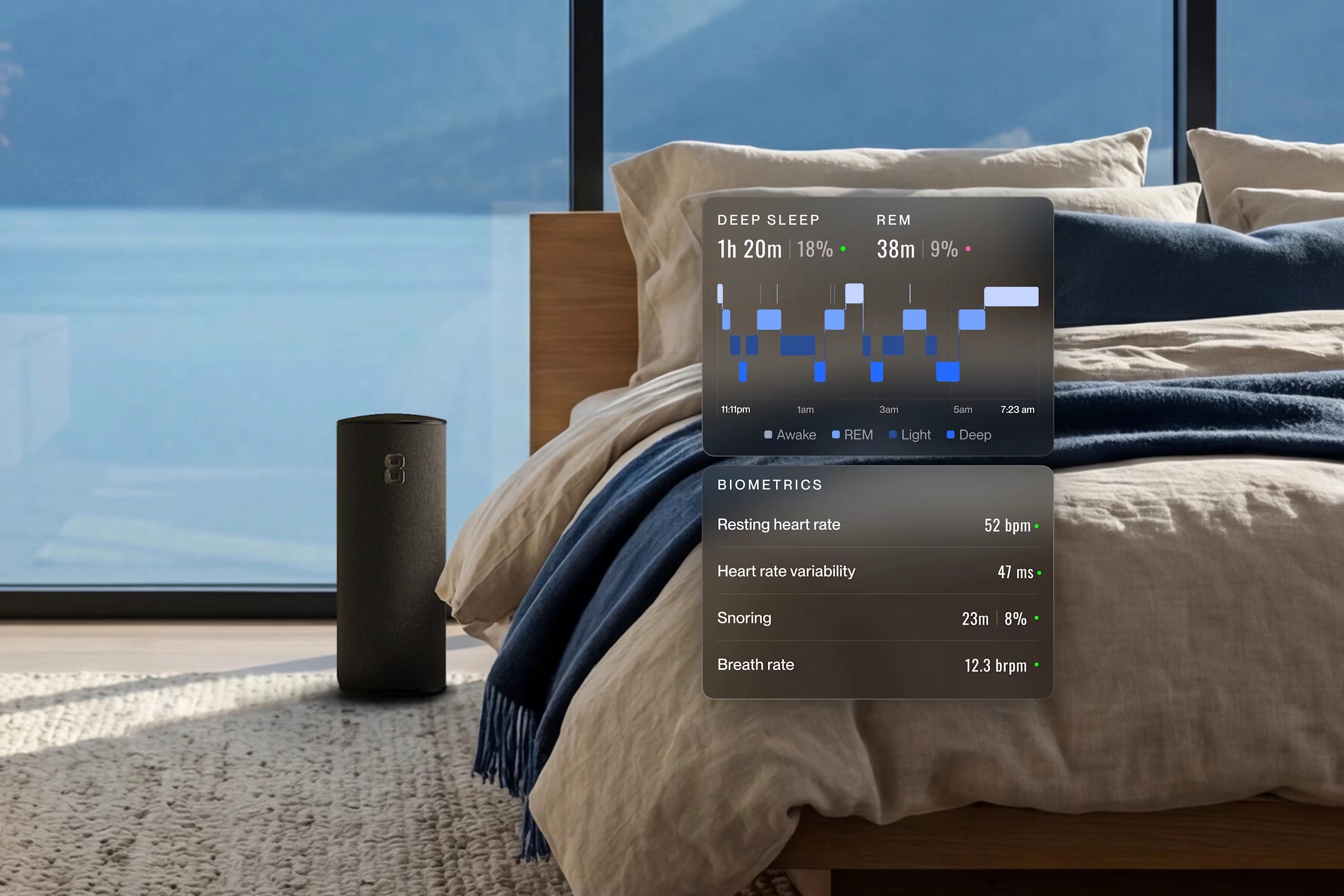
Eight Sleep made one clever decision early that shaped its competitive position. It built a cover, not just a mattress.
By decoupling its technology from the underlying sleep surface, Eight Sleep made its addressable market the entire installed base of existing beds. A customer does not need to discard a $5,000 mattress to adopt the Pod. They place a cover on top of what they already own. This eliminated the most significant barrier to purchase in a category where inertia is high and replacement cycles are long.
The incumbent response to this is structurally self-defeating. Tempur-Pedic’s value proposition is built on the proprietary feel of its memory foam — an identity so central to the brand that building a thin technology layer on top of competitors’ beds would require the company to declare, implicitly, that the foam is not the product. Serta and Simmons are embedded in physical retail distribution networks built around the furniture buying experience. A channel that is completely misaligned with the software-subscription economics Eight Sleep runs. To compete directly, these companies would need to build firmware engineering teams, manage cloud computing costs, train AI models, and sell software subscriptions. They would need to become something they are not.
The strategic logic extends to the attention economy. Eight Sleep is screenless. The Pod communicates nothing visible to the outside world and makes no demand on the user’s focus. It is infrastructure (running in the background, accumulating data, adjusting the environment) while the user is unconscious. In a landscape increasingly defined by devices competing for attention, this invisibility is a product decision with profound strategic implications.
What Might Keep Them Up
Besides the price, this all sounds great, but as is the case with any business there are genuine risks the bullish narrative tends to absorb without accounting for.
Sensor accuracy is contested terrain. The Pod’s embedded mattress sensors operate at a distance from the body and are susceptible to additional interference that wrist-based and ring-based wearables largely avoid. A partner rolling across the midline, a pet joining the bed, or any significant movement can confuse the biometric readings. Sleep stage data generated by the Pod frequently diverges from data captured by dedicated wearables such as the Oura Ring, which sits closer to the body’s arterial system. For a platform increasingly building its value proposition on the depth and reliability of its health data, measurement inconsistency at the sensing layer is a serious vulnerability.
The October 2025 AWS outage was a warning. Eight Sleep is selling hardware to users who then become dependent on the company’s continued operation for that hardware to function at all. Customer support has confirmed that if the company ceased operations entirely, the hardware would stop functioning. The outage mode patch addresses the symptom. It doesn’t resolve the deeper tension: consumer hardware priced above $2,000 that depends on a single company’s servers to remain operable is a different kind of commitment than a monthly software subscription, and as the installed base grows, that tension will resurface.
The most significant risk is regulatory. Eight Sleep has filed with the FDA for clearance covering sleep apnea detection and mitigation — a move that signals the company’s ambition to cross from consumer wellness into clinical diagnostics. The company is also exploring the use of its data network to test the efficacy of supplements. Both directions lead into regulated territory where the rules are materially different from consumer hardware. The timelines are longer, the standards are higher, and the cost of a product failure shifts from a support ticket to a liability event. WHOOP offers an instructive case study in just how uncertain that path can be. In July 2025, the FDA sent WHOOP a warning letter over its Blood Pressure Insights feature, arguing it functioned as an unapproved medical device. WHOOP refused to remove it, and the two sides remained at a standoff for nearly a year before the FDA reversed course this June, closing its enforcement action after WHOOP made cosmetic changes to the feature and the agency issued new wellness-device guidance in the company’s favour. The dispute ultimately resolved well for WHOOP, but the lesson for Eight Sleep isn’t that regulatory risk is overstated. It’s that the line between a consumer wellness feature and a regulated medical device is genuinely unsettled, and a company pursuing FDA clearance should expect a prolonged, unpredictable process rather than a straightforward approval.
The Test Ahead
The Eight Sleep story is in many ways just getting started. They have built the hardware, validated the science, and seeded the cultural reframe. For the wealthy. It will take time before prices come down enough to make Eight Sleep products accessible to the average consumer.
Beyond that, the question remains whether a consumer hardware company can accumulate enough proprietary biological data, at sufficient scale, to build AI that outperforms episodic clinical data in predicting and preventing disease. The jury is out.